
Subscribe
Services & Experiences
6 min read

William Milliken | Co-Founder, Swoop Scoop

How a frustrating pooper scooper experience turned into a fast-growing recurring-revenue service, why Swoop Scoop can be launched for under $200, and how automation, flat-rate pricing, and Facebook ads helped drive $200K+ in monthly revenue.
Written by
Roy Ben-Tzvi
Published on
June 24, 2026
William Milliken, Co-Founder of Swoop Scoop

William Milliken and Levi Swartz founded Swoop Scoop in late 2020 after spotting a massive gap in an often-overlooked corner of pet services: dog waste removal. What started as a frustrating personal experience quickly turned into a scalable, recurring-revenue business serving both residential and commercial clients.

In this interview, Milliken breaks down how Swoop Scoop got off the ground with minimal startup costs, why automation is core to the business, and how disciplined pricing and marketing decisions helped fuel rapid growth.

Can you tell us more about Swoop Scoop and how you initially got started with this business?

Swoop Scoop was founded in late 2020 by me and my business partner, Levi Swartz. I was already running a successful home service business when Levi approached me with the idea of starting another venture together. Around the same time, my wife had hired a pooper scooper service while she was pregnant, but the service we received was disappointing. That experience sparked the idea that we could do it better, and that’s how Swoop Scoop came to life.

Is it true that $174 a month is all you need to get the business off the ground?

Yes, you can start the business for as little as $174. That amount covers the basic equipment, like scooping tools and kennel-grade disinfectant, and you can start finding customers by posting in free buy/sell/trade groups.

However, if you want to invest in a business license, marketing, or if you need transportation, the initial costs will be higher.

How many of your backend processes have you automated, and how seamless is the customer experience? What tools or technologies have you implemented to streamline operations?

We’ve automated as much of our backend processes as possible to create a seamless customer experience. Our billing, routing, customer onboarding, and remarketing campaigns are fully automated, and we're also exploring automating payroll hours and performance pay in the future.

The main tool we rely on is a CRM called Sweep&Go, which helps us manage client data and operations efficiently. We integrate additional tools like EZ Texting, Mailchimp, and Paylocity to streamline communication, marketing, and payroll.

Would you be willing to share some key metrics of your business, such as profit margins, monthly recurring revenue (MRR), number of employees, and average subscription cost?

Our average customer pays around $105/month for services.

MRR varies based on the time of year. Last year we peaked at over $200,000/month in revenue, and we expect to grow way past that this year.

Employee counts also vary depending on the time of year. Over the last 12 months, we fluctuated between 15–30 employees depending on seasonality.

How did you acquire your first customers, and what strategies worked best early on?

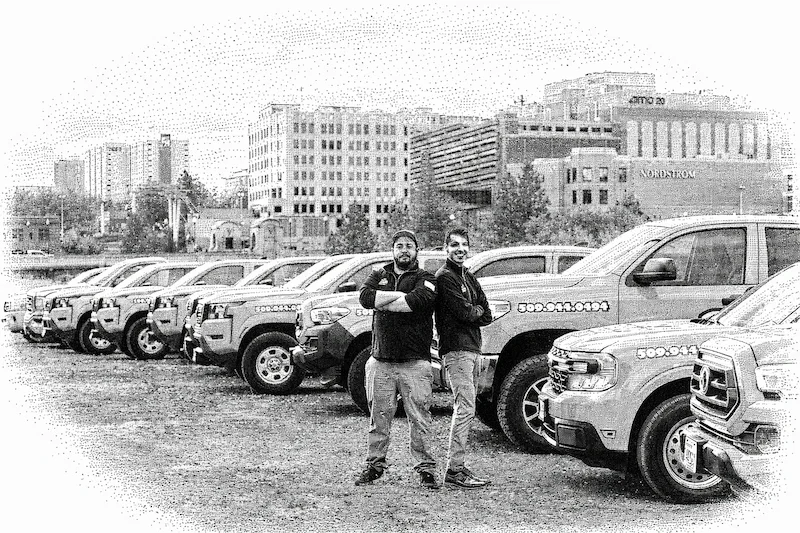
We got our first 15–20 customers by posting in free buy/sell/trade groups on Facebook. Once we had money to invest into marketing, we ran Google ads, Facebook ads, and eventually got full truck wraps.

FB Ads is our #1 channel.
Google is #2.
Truck wraps are #3.

Recently, we’ve implemented SMS and email remarketing campaigns that have been highly effective.

How do you identify and assess potential new markets for expansion?

We look at population size, percentage of dog ownership, proximity to our current locations, demographic information, housing pricing, household income, and average yard size.

How did you determine your pricing model, and what factors went into setting your rates?

We originally based our pricing off what local competitors were charging. We would never do this again. Now we base pricing on our expenses and how much profit we want to make for providing the service.

We are significantly more expensive than the majority of our competitors and are typically much larger because we have more resources dedicated to marketing, hiring employees, and building better systems.

All our pricing is flat rate and pre-billed on the first of each month.

What’s your best advice for an entrepreneur who wants to start a similar business?

Take advantage of all the educational resources out there for pooper scoopers.

Subscribe to newsletter

Join our newsletter to stay up to date on features and releases.

Thank you! Your submission has been received!
Oops! Something went wrong while submitting the form.

By clicking Sign Up you're confirming that you agree with our Terms and Conditions.

Pro
Keep Reading

Other Interviews

More conversations with founders, operators, and investors building the future of pet care.

Learn more
Tessa Olson | CEO, COVE Animal Health
Pet Health & Wellness
8 min read

Tessa Olson | CEO, COVE Animal Health

Tessa Olson's family spent nearly 90 years building Pieper Veterinary into a Connecticut institution. She rebranded it as COVE Animal Health and scaled it into a 20-hospital network across five states, backed by Chicago Pacific Founders. She explains what she screens for before a hospital joins, and where consolidation hollows a good practice out.

Learn more
Learn more
Dan Nagler | Co-Founder, Your Dog Is Bored
Retail & E-Commerce
11 min read

Dan Nagler | Co-Founder, Your Dog Is Bored

Dan Nagler spent years doing fractional BD for other pet brands before building one himself: a deck of activity cards aimed squarely at the 7 pm zoomies. One lunch with SodaPup's CEO turned into a campaign that moved nearly 700 decks with no marketing spend behind it. He walks through the local-store validation, why an analog product beats another app, and the inventory math he is sweating heading into SuperZoo.

Learn more
Learn more
Three Founders. One Cohort.
Pet Tech
10 min read

Three Founders. One Cohort.

Hundreds of startups applied to Pawsible Ventures' first venture studio cohort. Three of the founders who made it explain what actually got them in. Ana Malhotra on pivoting from Rome to Tato after watching a private dog park hand-check vaccine records every day, and on 65,000 pets already in the system. Lauren Burrows on the prelaunch deposits that proved Charlie Pet Health was more than a good idea, and a four-city expansion across the US and Canada. Davide Confalonieri on bootstrapping Lab4Paws through several pivots, and why execution, not the idea, was the deciding factor.

Learn more
View all interviews