Alternative Protein Pet Food: What Operators Need to Know Before Reformulating
The gap between "alternative proteins are interesting" and "here's what you can actually buy at scale" is wider than most founders realize. A practical guide to insect, plant, fermented, and cultivated proteins—what's commercially viable today.
You've seen the headlines. Insect protein is the future. Plant-based pet food is booming. Precision fermentation will change everything. But when you sit down with your formulator to discuss your next SKU, none of that trend coverage helps you answer the question that matters: which alternative protein actually makes sense for your product?
The gap between "alternative proteins are interesting" and "here's what you can actually buy at scale" is wider than most founders realize. This guide closes that gap.
The Alternative Protein Landscape in Pet Food
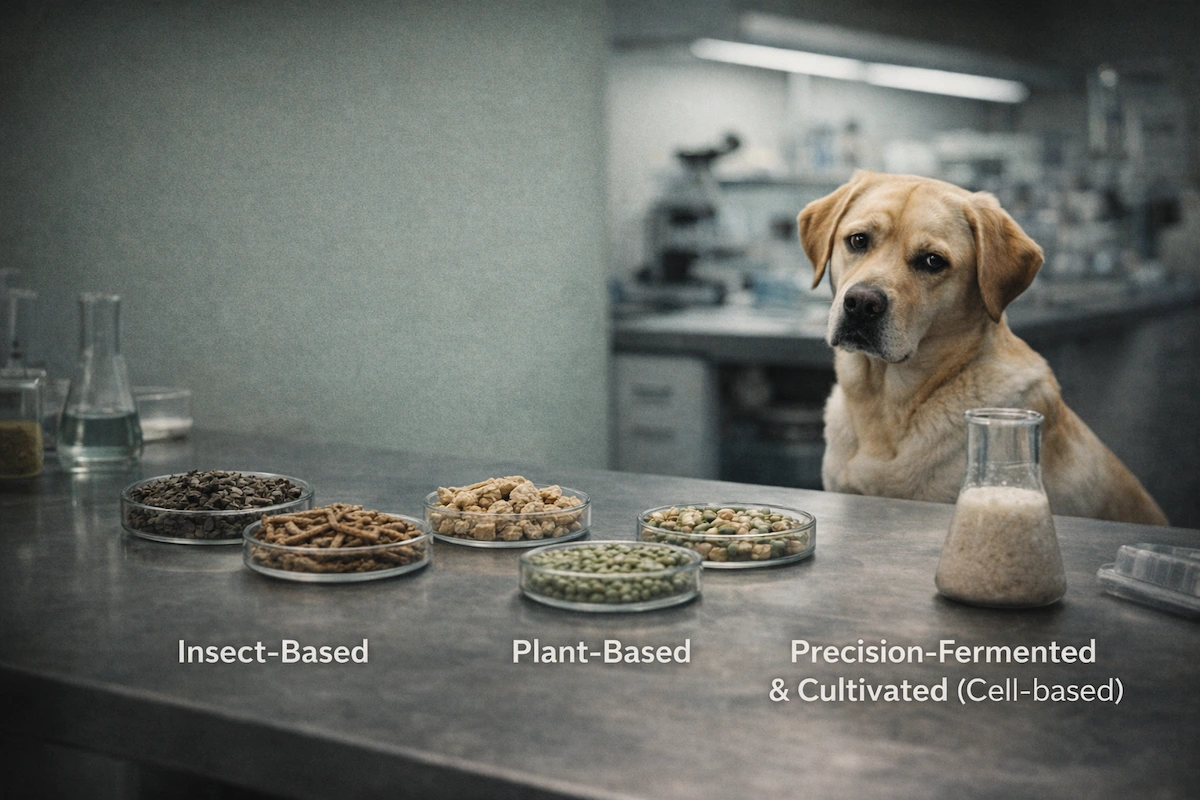
Alternative protein pet food encompasses four distinct categories, each at a different stage of commercial readiness. Conflating them is a common mistake — and an expensive one if you build a product around an ingredient you can't actually source.
Insect protein — primarily black soldier fly larvae (BSFL) and mealworm — is the most commercially mature alternative. Ÿnsect operates the world's largest insect farm at its vertical farming facility in Amiens, France. Protix (Netherlands) ranks among the biggest insect protein producers globally, while EnviroFlight (US), owned by Darling Ingredients, operates commercial-scale BSFL production.
Plant-based proteins — pea, lentil, chickpea, soy — have decades of use in pet food as supplementary protein sources. The shift now is toward plant-primary formulations, not just plant-inclusive.
Fermented and precision-fermented proteins represent the emerging middle ground. Bond Pet Foods produces animal-identical chicken protein through precision fermentation. The appeal is obvious: animal nutrition without animal supply chain complexity. The limitation: Bond's brewed chicken protein remains in late-stage development awaiting FDA regulatory approval, with commercial availability expected in the next couple of years.
Cultivated (cell-based) meat is advancing faster than many realize. Meatly received world-first regulatory approval from UK authorities (DEFRA/APHA) in 2024 to produce and sell cultivated chicken as a pet food ingredient. BioCraft has achieved price parity with premium traditional meat at $2.00-$2.50 per pound, though retail availability is still pending. For operators launching in the next 12 months, cultivated protein remains early — but it's closer to reality than the "years away" narrative suggests.
The operator's question isn't "which is most innovative?" It's "which can I actually formulate with today?"
Why Operators Are Looking at Alternative Proteins
The sustainability narrative dominates industry coverage, but operators pursuing alternative proteins are usually solving more immediate business problems.
Novel protein positioning drives many reformulations. Limited ingredient diets (LIDs) command premium pricing, and traditional novel proteins — venison, rabbit, kangaroo — face supply constraints and price volatility. Insect protein offers a genuinely novel option that most dogs have never encountered. Research suggests BSFL-based diets may benefit animals with sensitivities to conventional protein sources, as the lack of prior dietary exposure reduces sensitization risk.
Supply chain diversification became urgent after protein price volatility in recent years. Operators who'd built their entire line around one protein source faced margin compression or reformulation under pressure. Alternative proteins offer a hedge — not a replacement for traditional proteins, but insurance against volatility.
Margin structure varies significantly by category. Plant proteins typically cost less than animal meal. Insect protein costs 3-5 times more per kilogram than chicken meal, a premium that currently limits mass adoption. But the margin calculation includes positioning: a $60/bag insect-protein kibble competes in a different segment than a $35/bag chicken formula. The relevant question isn't "what's cheapest?" but "what margin does my positioning support?"
For most operators, the decision to explore alternative proteins combines all three factors. Pure sustainability marketing rarely justifies the formulation complexity.
The Four Categories and What They Actually Mean for Formulation
Insect Protein
Black soldier fly larvae (BSFL) have emerged as the insect of choice for pet food. The protein content ranges from 40-60% on a dry matter basis, with a complete amino acid profile comparable to fish meal. Digestibility studies show BSFL meal achieves apparent total tract crude protein digestibility comparable to or exceeding poultry meal, with research demonstrating digestibility above 80%.
From a pet food formulation perspective, insect protein behaves similarly to traditional animal meals. It processes well through extrusion, the dominant manufacturing method for dry pet food. Your co-packer likely won't need new equipment.
The sourcing reality: Ÿnsect, Protix, and EnviroFlight are the major suppliers with commercial-scale operations. Minimum order quantities and lead times vary by supplier and relationship — expect to negotiate directly for specific terms.
The regulatory picture differs by geography. In the EU, no restrictions exist on feeding insect protein to pets, though regulations govern production standards. In the US, AAFCO approved dried black soldier fly larvae in January 2021 for adult dog food — the first insect ingredient approved for pet food. Mealworm protein received AAFCO approval in January 2024, also for adult dogs. Notably, no insect proteins are yet AAFCO-approved for cat food.
Plant-Based Proteins
Pea protein, lentil, chickpea, and soy offer the cost advantage in alternative proteins. They're abundant, supply chains are mature, and pricing is stable relative to animal proteins.
The formulation challenges are real. Taurine is completely absent in plant sources — 0 mg in rice, oats, corn, wheat, lentils, peas, and soy. Dogs can synthesize taurine from methionine and cysteine, but cats cannot synthesize taurine at all. Any plant-primary formula requires synthetic supplementation to meet AAFCO nutrient profiles.
Palatability is the other constraint. Dogs generally accept plant-based formulas, though acceptance rates vary. The bigger challenge is cats — obligate carnivores with strong protein-source preferences. Plant-primary cat food exists (brands like Ami Cat and Benevo), but market share remains small compared to dogs.
Anti-nutritional factors (ANFs) in legumes — phytates, lectins, trypsin inhibitors — require processing to neutralize. Most co-packers handle this through standard extrusion, but confirm your manufacturing partner's experience with plant-heavy formulations.
Fermented and Precision-Fermented Proteins
Precision fermentation produces animal-identical proteins without the animal. Bond Pet Foods' brewed chicken protein (BCP) uses genetically engineered brewer's yeast with chicken muscle protein DNA sequences, fermented in industrial tanks and spray-dried into powder.
A six-month University of Illinois feeding trial confirmed BCP's safety, high digestibility, and nutritional efficacy — exceeding AAFCO standards for adult dogs with benefits including improved gut microbiota and increased short-chain fatty acids. Bond has partnered with Hill's Pet Nutrition to develop custom precision-fermented proteins, signaling major manufacturer interest.
Traditional fermented proteins — primarily yeast-based — have longer track records in pet food. Brewer's yeast has been an ingredient for decades. Newer single-cell proteins offer higher protein concentrations, but supply remains limited compared to insect or plant options.
If precision fermentation interests you, the move is to get on supplier waitlists now while building current products around ingredients you can actually source.
Cultivated Meat
Cell-cultured meat represents the theoretical endpoint of alternative protein: real animal tissue, grown without the animal. The space is moving faster than expected.
Meatly received full regulatory approval in the UK in 2024 and is actively supplying cultivated chicken to pet food manufacturers, with plans to scale to industrial volumes by 2026-27. BioCraft uses AI and machine learning to optimize cell growth, producing unstructured "meat slurry" from mouse cells as a direct replacement in wet and dry pet foods.
For operators making launch decisions today, cultivated meat is still early-stage — but the regulatory and cost barriers are falling faster than industry coverage suggests. Track the space actively.
Cost and Sourcing Realities
The pricing conversation operators actually need centers on relative positioning rather than exact figures, which shift constantly.
Insect protein costs 3-5 times more per kilogram than poultry meal at current commercial volumes. This premium stems from high production costs, limited scalability, and specialized farming and processing requirements. Plant proteins cost less than traditional animal meal. Precision-fermented proteins, where commercially available, command significant premiums.
The relative positioning matters more than exact numbers: insect protein is a premium ingredient that requires premium positioning. Most operators pursuing insect protein price into the $55-70/bag segment rather than absorbing the cost differential.
Geographic factors matter. EU suppliers ship to the US, but logistics add cost and complexity. US-based insect production (EnviroFlight) simplifies supply chains for domestic manufacturers.
The global pet food insect protein market reached approximately $650 million in 2025, growing at 22% annually. This growth reflects increasing demand, but also indicates the category remains niche relative to traditional proteins. As production scales — Ÿnsect targets 20,000 tons annually — costs should decline, but insect protein will remain costlier than chicken meal for the foreseeable future.
Formulation Trade-Offs Your Co-Packer Will Flag
Before you commit to an alternative protein, your formulator will raise several practical concerns.
Palatability testing is non-negotiable. Dogs are more flexible than cats, but acceptance varies by protein source and processing. Budget for palatability trials before finalizing formulation — scope and cost vary based on testing methodology and number of variants.
Amino acid balancing requires attention with any alternative protein. AAFCO nutrient profiles specify minimum levels for essential amino acids. Plant proteins require methionine supplementation; AAFCO sets minimum methionine-cystine at 0.65% for adult dog maintenance. Insect proteins may need taurine supplementation depending on inclusion rates. Your formulator handles the calculations, but understand that "complete and balanced" claims require hitting these targets.
Processing compatibility varies. Insect meal extrudes well. Plant proteins extrude well. Fresh and freeze-dried formats may require different considerations. Confirm your co-packer's experience with your chosen protein in your chosen format.
Shelf stability can differ from traditional formulations. BSFL contains 40-50% lauric acid in its fat profile, which affects oxidation characteristics. Discuss packaging and shelf-life expectations with your manufacturer.
AAFCO compliance with novel ingredients requires documentation. For insect protein, AAFCO-approved ingredients (BSFL for adult dogs) simplify the process. For newer ingredients, you may need to work through the GRAS (Generally Recognized as Safe) process or other regulatory pathways.
The Cat Problem
Most alternative protein content focuses on dogs. There's a reason: cats are harder.
Cats are obligate carnivores requiring specific amino acids — taurine, arachidonic acid, preformed vitamin A — that dogs can synthesize but cats cannot. AAFCO requires minimum taurine of 25 mg/100 kcal for dry cat food and 50 mg/100 kcal for canned. Any cat formula must provide these directly, regardless of protein source.
Beyond nutrition, cats are notoriously selective eaters. Palatability that works for dogs often fails for cats. Plant-primary cat food exists, but market share remains tiny.
Insect protein shows more promise for cats than plant-based options. The amino acid profile is closer to traditional animal protein, and early palatability data is encouraging. Lovebug, developed by Mars Petcare in partnership with the Waltham Petcare Science Institute, launched as the UK's first fully insect-based cat food. The dry kibble contains 30% dried insect meal and is nutritionally complete and balanced. Other insect-based cat food brands include Catit Nuna, Tomojo, and Entoma.
If you're formulating for cats, expect:
- Higher formulation complexity
- More extensive palatability testing
- Longer development timelines
- Smaller initial market
Don't ignore cats entirely — the competitive landscape is less crowded, and no insect proteins are AAFCO-approved for cats yet, creating first-mover opportunity when that changes. But budget for the additional complexity.
Questions to Ask Before You Commit
Before signing with an alternative protein supplier, get clear answers:
Supply questions:
- What's your current production capacity? What's planned for next year?
- What's your MOQ? Can we start smaller for trial runs?
- What's the lead time for first order? For reorders?
- Do you have US-based inventory, or does everything ship internationally?
Quality questions:
- What's the protein content specification? What variance is acceptable?
- How do you handle batch-to-batch consistency?
- What third-party certifications do you hold?
- Can you provide digestibility and amino acid profile data?
Regulatory questions:
- Is this ingredient AAFCO-approved for the species I'm targeting?
- What documentation do you provide for state registration?
- Have other pet food manufacturers successfully launched with your ingredient?
Red flags:
- Vague answers about production capacity
- No existing pet food manufacturer references
- Inability to provide nutritional specifications
- Minimum orders that exceed your annual needs
The suppliers who want your business long-term will answer these questions directly. The ones who can't are either too early-stage or not serious about the pet food market.
Alternative proteins aren't a trend to chase — they're an ingredient category to evaluate like any other. The operators who succeed will be the ones who match protein choice to positioning, confirm supply before committing, and budget for the formulation complexity that comes with any novel ingredient.
The question isn't whether alternative proteins belong in pet food. They already do. The question is whether they belong in your product.
Affiliated Products
Lorem ipsum dolor sit amet, consectetur adipiscing elit. Suspendisse varius enim in eros elementum tristique. Duis cursus, mi quis viverra ornare, eros dolor interdum nulla, ut commodo diam libero vitae erat.