Nutramax takes its Consil brand from bone grafts to wound dressings
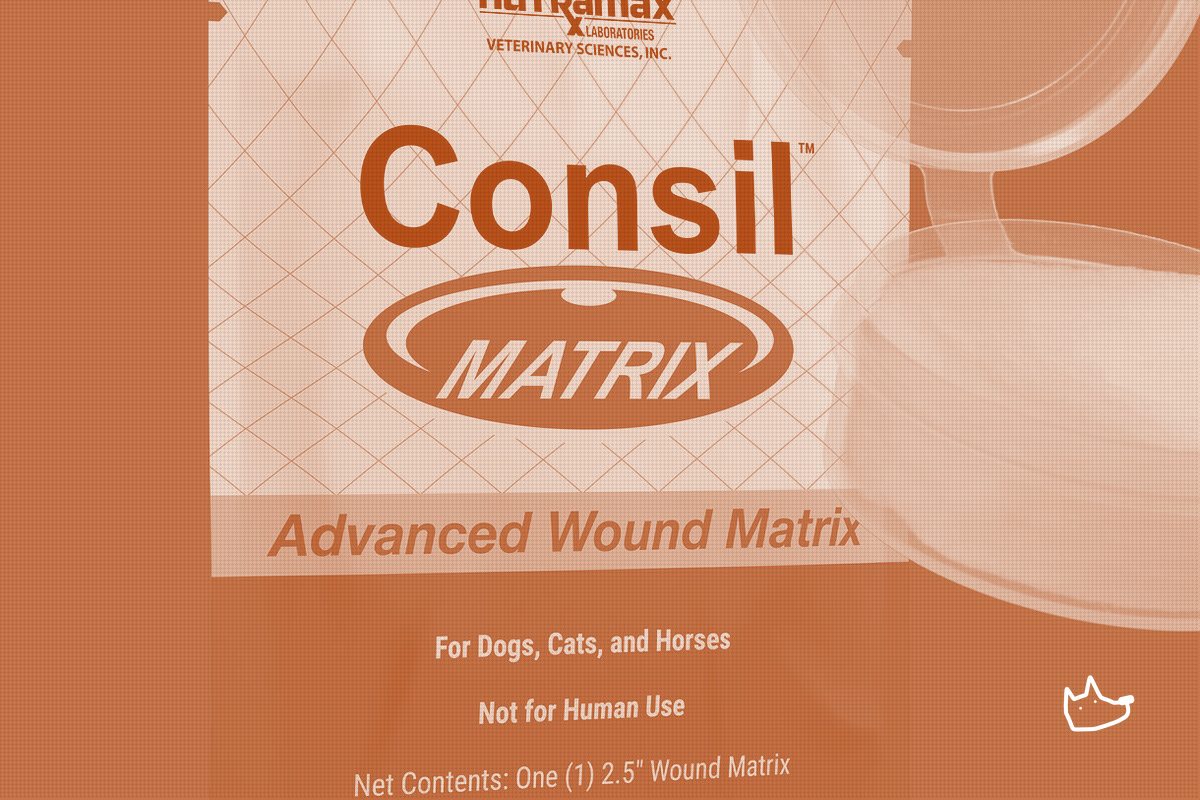
Nutramax Laboratories Veterinary Sciences launched Consil Matrix, a silica-fiber wound dressing for dogs, cats and horses, through a relationship with SiOxMed, whose human silica-fiber wound matrix holds FDA 510(k) clearances. The release does not say the two are the same material. Animal devices need no FDA premarket review, and no published veterinary study of the material turned up in our search.
A joint supplement whose trademark filing dates to 1992 turned a supplement maker now based in Lancaster, South Carolina, into a fixture of the American vet clinic. On October 1st, 2026, that company's veterinary arm, Nutramax Laboratories Veterinary Sciences, put a silica-fiber wound dressing for dogs, cats and horses on the same counter. No federal premarket review is required for it, so the evidence question now sits with the clinics that buy it.
A familiar name with a human wound-care partner behind it
Consil Matrix is described by the company as an "extracellular matrix-inspired wound care product composed of amorphous silica-based microfibers." In company-reported terms, it helps control bleeding, promotes clot stabilization and helps maintain moisture balance in the wound. A companion product, Consil Matrix Topical Cream, is a fragrance-free, non-medicated cream for routine skin conditioning.
Nutramax says the launch comes "through its relationship with SiOxMed," a North Carolina device maker. SiOxMed's own human product, SiOxD Wound Matrix, is a non-woven fiber matrix of hydrated amorphous silica that has received three FDA 510(k) clearances since its first finding of substantial equivalence on November 18th, 2022. The most recent, cleared on July 5th, 2024 as a line extension that allowed an alternate water raw material, rested on material and sterilization testing and kept the human indications for partial and full-thickness wounds, ulcers, surgical wounds and partial-thickness burns. SiOxMed also won clearance for a SiOxC Cream on March 13th, 2025. The release does not say Consil Matrix is the same material, and it discloses no licensing terms, pricing or distribution channels.
"Veterinary wound management can be challenging, and having effective, easy-to-use options available is important for veterinary professionals," said Todd Henderson, DVM, President and CEO of Nutramax Laboratories Veterinary Sciences, Inc.
The human clearance proves less than it seems
SiOxD's 510(k) clearances find substantial equivalence to existing devices for human wound indications, and they say nothing about animals. For the veterinary market, FDA does not require a 510(k), PMA or any premarket approval for devices intended for animal use. The manufacturer is responsible for making sure the product is safe, effective and properly labeled, and FDA can act if a device is misbranded or adulterated.
That shifts the burden of proof. A search we ran on October 5th, 2026 found no peer-reviewed study of Consil Matrix or SiOxD in dogs, cats or horses. The closest published work is a vendor-sponsored biocompatibility abstract by SiOxMed staff that included a porcine wound model, and a multicenter retrospective study of 11 horses published in JAVMA in April 2023 that tested Zarasyl, a different company's amorphous silicate barrier cream.
The category itself is modest but growing. A third-party estimate puts global animal wound care at $1.38B in 2025 and $1.49B in 2026, with an expected 8.9% annual growth rate carrying it to $2.1B by 2030. By our math that forecast implies annual global sales rising about $610M from 2026 to 2030, roughly 41% growth in four years. U.S. clinics are only a slice of that base.
A surgical brand gets a second act in soft tissue
This is not the company's first device. Nutramax already sells Consil synthetic bone graft particulate, a bioactive glass for orthopedic and dental defects, and filed the Consil trademark for veterinary bone grafts on February 20th, 1996. The wound line borrows a name that until now belonged to grafts used in surgery and dentistry.
If we had to guess, the advantage here is distribution, not data. The same sales relationships that move Cosequin and Dasuquin can put a dressing in front of practices at little added cost. We could be wrong, but practices weighing a switch will likely ask for species-specific outcomes before the brand name does the selling.
The burden of proof is on the seller.
Source: Nutramax Laboratories Veterinary Sciences via PR Newswire
Other News
More stories shaping the pet industry this week. From funding rounds and product launches to regulatory shifts and retail strategy, stay ahead of what's driving the market.

Zoom Room returns to franchising with 18.2% same-store sales growth
Zoom Room reported 12.0% and 18.2% same-store sales growth in Q2 and Q3 after pausing development in late 2025, and 15.1% for units open more than a year. It now resumes franchise sales with two quarters of operating data, and a 550-gym target that implies about 120 openings a year.
MPM Products recertifies as a B Corp under B Lab's audited new standards
The owner of Applaws, Reveal and Encore is one of 20 UK companies in the first cohort to certify under B Lab's rewritten standards, which add third-party assurance and a five-year cycle. With the EU's sustainability label rules applying from September 27th, 2026, B Lab says an assured B Corp badge now qualifies as a valid label.

Cat food owner hands North America to its marketing chief
MPM Products, the owner of Applaws, Reveal and Encore, has named global CMO Samantha Greenwood president of North America. The US brings in more than 40% of company revenue, and we read the pick as fitting Partners Group's cat-focused growth thesis in a pet food category APPA expects to grow about 2% in 2026.