Which Parts of Pet Food Manufacturing Are Worth Owning? What 2026's Plant Deals Show
Purina built a $550M plant, Golden Pet bought a freeze-drying plant for its own brands and Instinct brought HPP in-house. What the 2026 manufacturing moves show about which parts of making pet food are worth owning.
Key findings
- Purina opened a $550M, 1.3M sq ft plant in Batavia, Ohio in 2026, its first US plant built from scratch since 1975.
- Golden Pet Brands bought PetSource, a 170,000 sq ft freeze-drying plant with about $130M of capex since 2020, and moved it to its own brands.
- Instinct put about $160M into a 130,000 sq ft Lincoln, Nebraska site that brought freeze-drying and HPP under one roof and cut product touches by about 70%.
- One rule of thumb from pet supplement research by William Blair and CIL: owning a plant starts to make sense when a brand can fill about 70% of it on day one.
- Across two research passes on 30+ pet food brands, owning manufacturing did not predict more published product research. Category and positioning mattered more.
How we know: The Underbite reviewed company announcements, filings, job posts and trade coverage for the companies named, and ran two research passes on published product research at 30+ pet food brands, September 2026.
Golden Pet, Purina and Instinct are doubling down on owning how their products get made. From freeze-drying capacity to HPP lines and co-man platforms, pet brands are choosing very different ways to control how their products get made as food and supplements get harder to differentiate.
PetSource, a 170,000 sqft freeze-drying facility in Seward, Nebraska, has absorbed roughly $130M in capex since Scoular opened it in 2020. Scoular built the operation to make freeze-dried food for other brands and 3x’d its capacity in 2024 to make room for existing customers and new ones.
Golden Pet Brands bought the facility in May 2026 and dedicated it to its own portfolio, with the company specifically naming Dr. Marty Pets and Ultimate Pet Nutrition. The same plant Scoular had spent years building as infrastructure for outside companies now sits inside a portfolio with plenty of its own volume to feed through it.
That deal lands alongside several other manufacturing bets that look very different on paper.
Purina opened a $550M, 1.3M sqft factory in Batavia, Ohio, its first U.S. plant built from scratch since 1975 and the largest manufacturing investment Nestlé has ever made in Purina. The site will eventually employ more than 500 people and produce enough food for roughly 8M pets a year.
Spot & Tango is putting another $20M+ into its Allentown facility because UnKibble is already pushing against the limits of a plant that opened only four years ago. Blue Sea Capital, meanwhile, acquired CompletePet, a co-man platform that grew from one 55,000 sqft operation to more than 350,000 sqft under Align Capital while continuing to formulate and manufacture products for outside brands.
Update, November 2nd, 2026: Two deals since this first ran moved the other way. Wellness Pet sold its Decatur, Arkansas dry-food plant to private-label maker United Petfood for $24.22M with a long-term supply agreement, per Talk Business & Politics. And i-Tail bought US treat co-man Phelps Pet Products at a $160M enterprise value, per Feed & Additive.
Those moves get lumped together under vertical integration pretty quickly, but they are solving very different problems.
The better question is which parts of making the product are important enough to own.
(For the general math on co-packing, building and buying, see our pet food manufacturing decision framework. This piece looks at what the biggest 2026 moves actually show.)
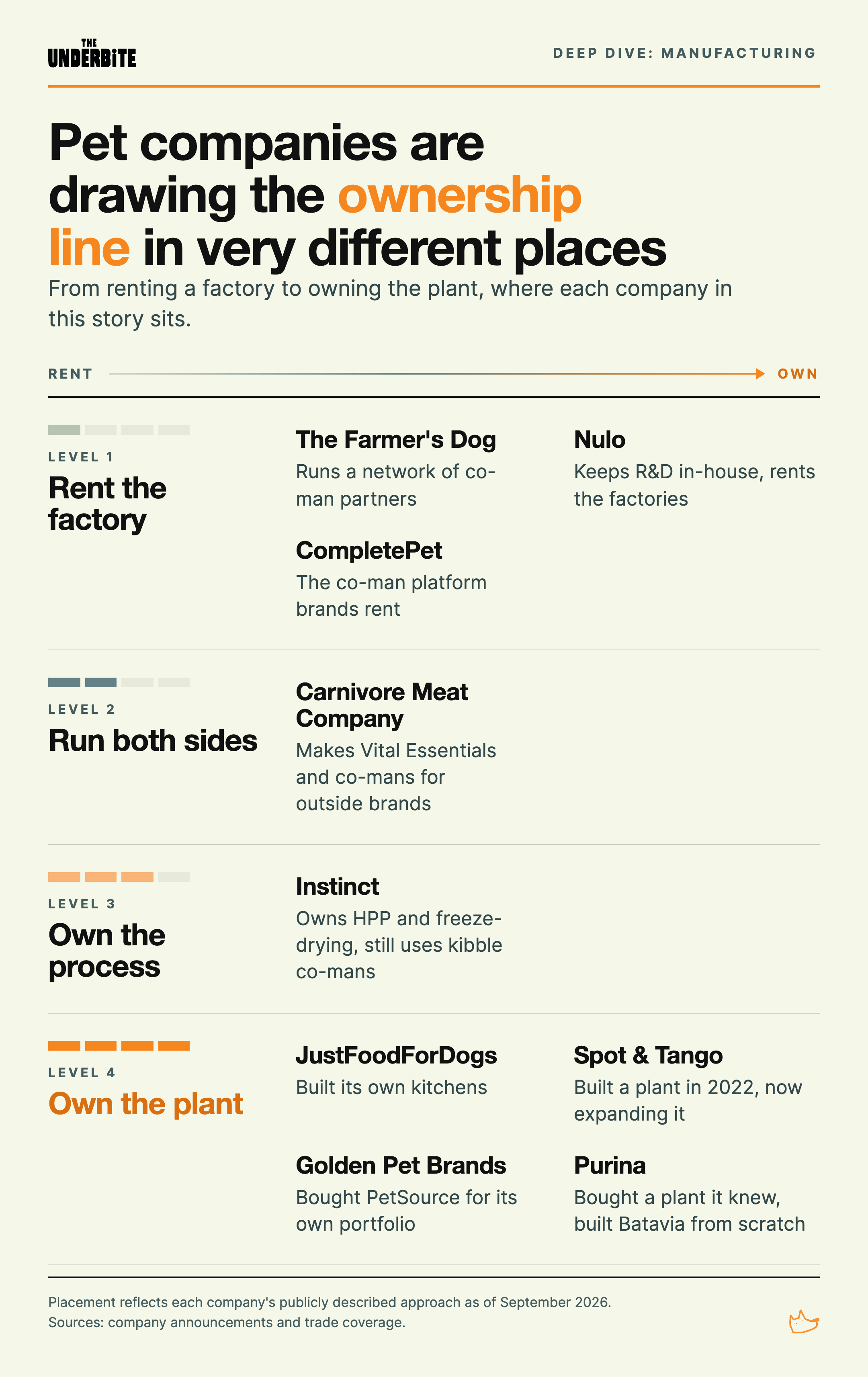
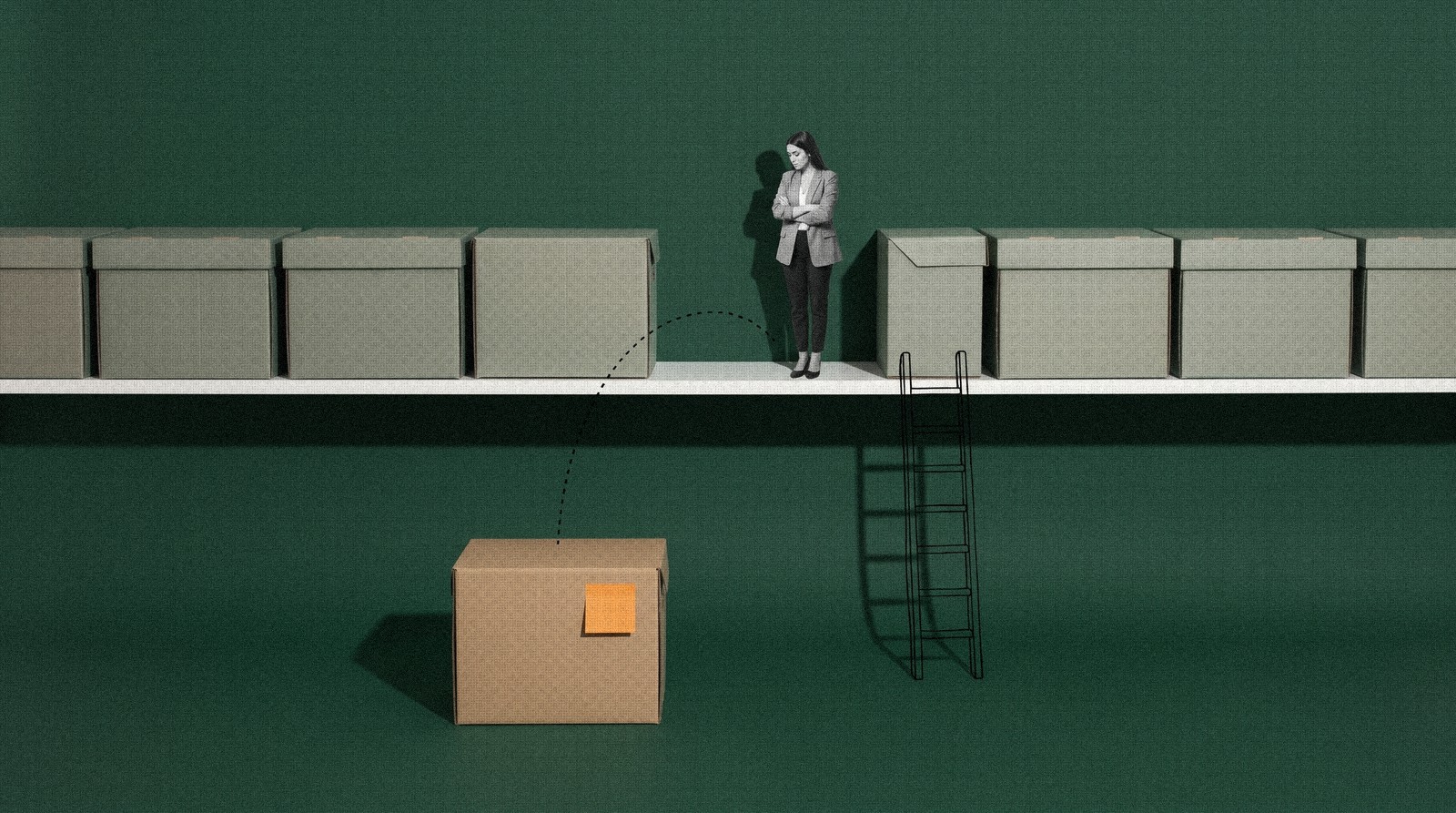
Data behind the chart: where each company sits, from rent to own (September 2026)
- Level 1, rent the factory: The Farmer's Dog (network of co-man partners), CompletePet (the co-man platform brands rent), Nulo (keeps R&D in-house, rents the factories)
- Level 2, run both sides: Carnivore Meat Company (makes Vital Essentials and co-mans for outside brands)
- Level 3, own the process: Instinct (owns HPP and freeze-drying, still uses kibble co-mans)
- Level 4, own the plant: JustFoodForDogs (own kitchens), Spot & Tango (built a plant in 2022, now expanding it), Golden Pet Brands (bought PetSource for its own portfolio), Purina (bought a plant it knew, built Batavia from scratch)
Purina is using both sides of the build-or-buy playbook
Purina’s Batavia plant is the long game.
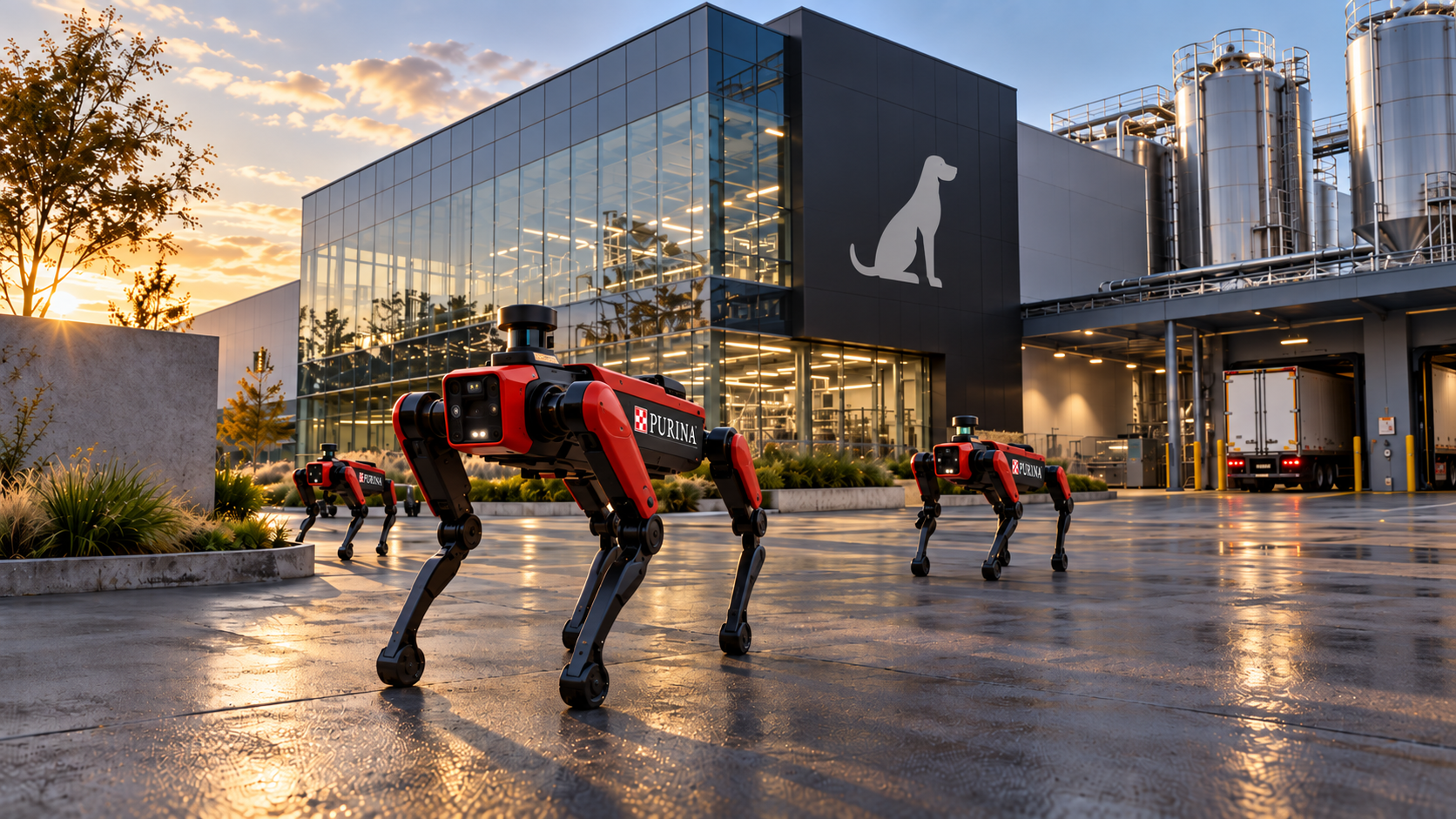
The company started with bare ground and built a highly automated factory capable of flexing across Pro Plan, Purina ONE and Dog Chow for years. Automated storage, digital manufacturing systems and robotics run throughout the site, including a Boston Dynamics robotic dog named Spot that handles thermal and acoustic equipment inspections.
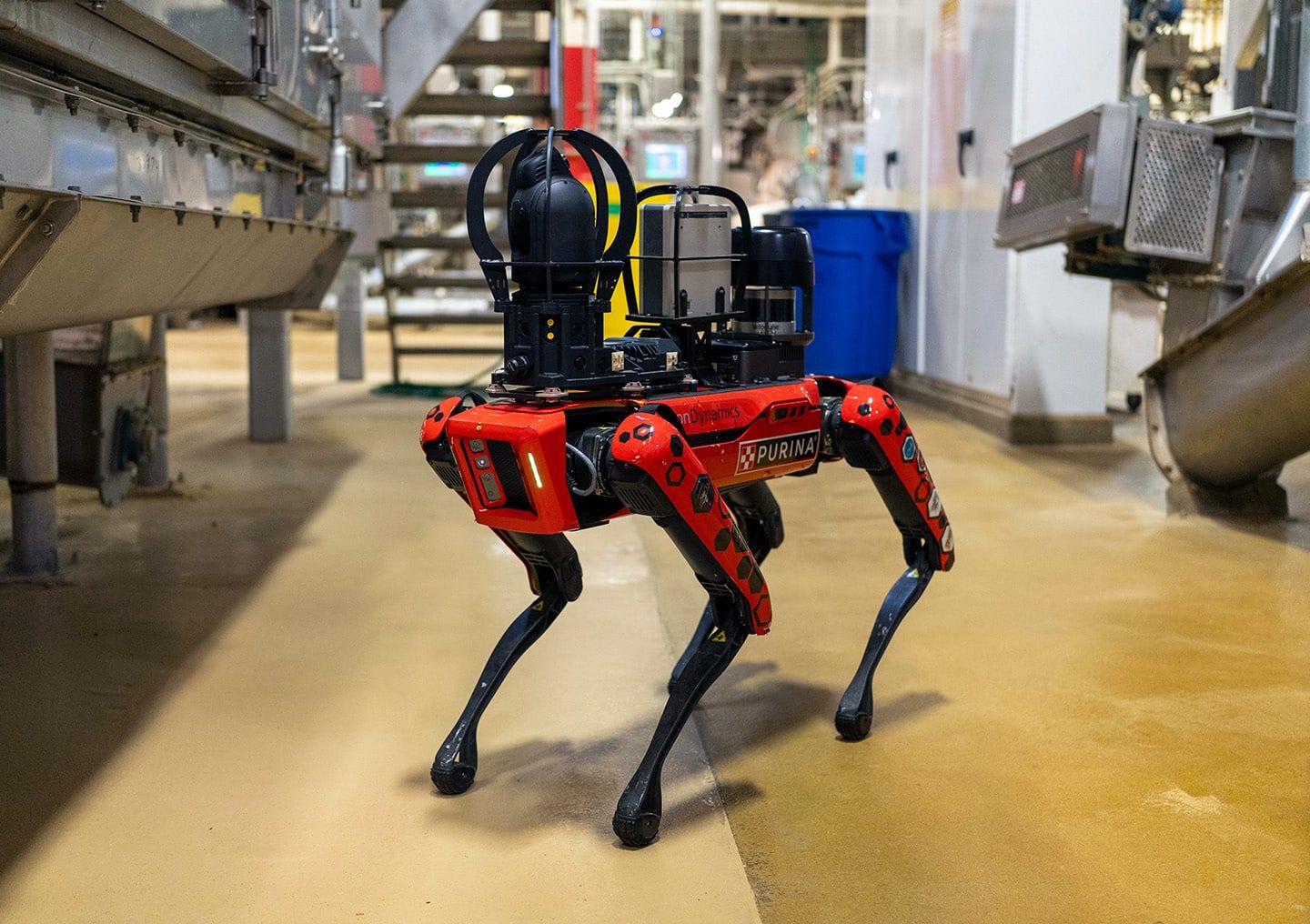
Spot at Nestlé Purina | Credit: Boston Dynamics
Using a robotic dog to help make dog food feels like a clip pulled from The Simpsons or Idiocracy.
A few years earlier, Purina solved a much narrower production need by buying a factory it already knew.
Red Collar Pet Foods had been created in 2018 when Mars sold five U.S. private-label plants to Arbor Investments. Arbor upgraded the network, added treat manufacturing and built Red Collar into a larger co-man platform serving national brands.
Hill’s eventually paid $700M for three of Red Collar’s dry-food plants while its own capacity constraints were weighing on volume.
Purina acquired another Red Collar operation in Miami, Oklahoma after spending roughly a year running Purina and Zuke’s soft chews through it. By the time the deal happened, Purina knew the people running the lines, the quality systems had been tested and the factory was already making the actual SKUs it cared about. Purina specifically pointed to the plant’s existing soft-treat capabilities and safety record when it announced the acquisition.
That is a much easier acquisition to underwrite than a theoretical plant plopped onto a spreadsheet.
William Blair and CIL heard a useful rule of thumb while researching pet-supplement manufacturing. One executive told them plant ownership starts to make sense when a brand can fill roughly 70% of the facility on day one, particularly when it already knows the manufacturer.
Purina’s Miami deal looks pretty close to that in practice.
Batavia keeps the lesson from becoming “buying is better.” Purina will invest heavily in a greenfield factory when the scale and time horizon support it, and it will buy an existing plant when a specific capability is already working.
Fresh food shows how different the winning formulas can be
The Farmer’s Dog and JustFoodForDogs have both built major fresh-food businesses with very different capital stacks.
The Farmer’s Dog has delivered more than 1B meals and still runs a meaningful network of manufacturing partners. Its September 2026 opening for a Senior Manager of Contract Manufacturing owns relationships with multiple co-mans, tracks cost per pound and yield, works on capital projects inside partner facilities and helps decide where future capacity should sit.
JustFoodForDogs reached almost the opposite conclusion early.
Founder Shawn Buckley has said visits to third-party manufacturers convinced the company that it would struggle to maintain the ingredient and production standards it wanted through outside factories, so it built its own kitchens. That manufacturing model eventually became part of the customer experience, and JustFoodForDogs now operates open kitchens where customers can watch food being made, including locations in some very expensive retail markets.
Both companies have put serious resources behind brand, science, product development, acquisition and distribution. Their winning formulas simply reflect very different core beliefs about how to build a defensible product and company.
The Farmer’s Dog has been able to push enormous volume through manufacturing partners while concentrating heavily on acquisition, personalization, retention and logistics. JustFoodForDogs accepted a much heavier physical footprint and made the kitchen itself part of the proposition.
Both approaches have worked.
We were curious whether the same split showed up in product science, so we ran two independent research passes across more than 30 strategically important pet-food brands, and neither found a clean relationship between owning manufacturing and investing in feeding trials, clinical studies or other product-level research.
The clearer pattern was by category and brand positioning. Fresh brands and the legacy veterinary-science players consistently had more publicly available product research, while raw, freeze-dried and air-dried brands generally had much less, even when they owned meaningful production.
Pet food and supplements are both insanely crowded
Brands only have so many places to create real daylight. Formulation and form factor matter, feeding trials and clinical studies matter more than ever, processing can become part of the product story, and a great marketing and distribution machine can still overpower almost everything if you are good enough at it.
Nulo shows how one of those bets can look in practice. The company has kept deep nutrition and formulation expertise inside the business while continuing to rely on outside manufacturing partners.
COO Greg Aldrich has spent decades on the technical side of pet food. His background includes nutritional development and new technology at Iams, R&D leadership at Kemin Industries, product development at Menu Foods and more than a decade building Kansas State’s pet-food program.
That is a lot of formulation and processing experience sitting inside one company.
Aldrich and his team developed Nulo’s cold-pressed line, which launched in 2024 as a shelf-stable format positioned between conventional kibble and freeze- or air-dried food. Nulo says the process allows it to use 3x the meat inclusions of conventional kibble, with 85% animal ingredients by weight and 95% of the protein coming from animal sources. Feeding trials on the diets also reported more than 90% protein digestibility and 96% fat digestibility.
Nulo still manufactures through a network of partner facilities.
You can own the nutrition expertise, formulation, product development and research without deciding that running factories also needs to become a core competency.
Processing can become part of the brand itself
High Pressure Processing (HPP) is a good example of a manufacturing step carrying a lot more strategic weight than the name suggests.
HPP is basically a very expensive way to crush the life out of pathogens without cooking the food.
That is useful if the whole proposition is built around raw or minimally processed nutrition. Stella & Chewy’s runs its raw products through HPP, We Feed Raw uses the process across its recipes, and other scaled raw brands including Primal and Instinct have incorporated HPP into their food-safety programs.
The technology itself has been used in human food for decades.
About 10 years ago I actually got pretty far down the road on launching a bottled lemon water that I wanted to call Pheels, a play on pH levels, lemons, the acid zing, blah blah blah. It sounded great in my head.
The ingredients were deliberately simple, which meant I wanted the package and overall experience to carry more of the brand. I had this picture of a clean lemon water in an elegant glass bottle that felt thoughtful rather than looking like another label slapped onto another plastic bottle.
I remember dawdling on plastic because it would have made the entire thing much easier.
But I could already hear the question before we sold a single bottle. Another single-use plastic bottle? Just what we need.
I did not have a good answer.
Glass made the manufacturing side a headache. If I wanted enough refrigerated shelf life to move well outside a local market, HPP was the route I kept running into, and the co-packers I found were built around packaging that could flex under enormous pressure.
Sol-ti was the only cold-pressed juice company I knew doing glass at meaningful national scale, and it had solved the problem differently by building around a proprietary UV-light process. The company still uses UV instead of HPP or heat, which allowed glass to become part of both the product and the brand.
I eventually canned Pheels (sigh).
Lemon Perfect launched shortly afterward in plastic and later reached a reported $150M valuation. Sol-ti took the more complicated glass-and-UV route and has also built a sizable business.
Two completely different production decisions. Both valid.
Beeb’s is doing a smaller version of this in pet today. The treat itself is extremely simple, single-ingredient lamb lung, while the brand has made plastic-free, recyclable and home-compostable packaging one of the defining pieces of the proposition.
These choices are easy to gloss over when the priority is getting a SKU to market. They can eventually dictate packaging, shelf life, capex, distribution and the story the customer hears.
Something that looks like a boring manufacturing constraint from the outside can become a meaningful part of the brand.
Instinct brought the process itself inside
Instinct shows what happens when processing becomes important enough to justify real infrastructure.
The company invested roughly $160M into its Center of Excellence in Lincoln, Nebraska, creating a 130,000 sqft operation that brought freeze-drying and High Pressure Processing (HPP) under one roof. Before the consolidation, product moved through several facilities and outside HPP tolling providers. At one point, Instinct says raw material traveled nearly 47 miles around Lincoln before becoming finished food.
The new setup cut that travel to essentially zero and reduced product touches by roughly 70%.
Instinct gained tighter control over food safety, production time, raw handling and how HPP and freeze-drying work together. The company also uses that infrastructure to support newer formats such as FreshRaw Meals, while some freeze-dried inclusions still leave Lincoln for final assembly at kibble co-man partners.
There is also a less comfortable part of the co-man decision.
Capacity and quality are practical concerns, but there is always the slightly more paranoid possibility of a lil espionage.
I don’t mean a manufacturer literally stealing a customer’s formula.
The more realistic issue is knowledge leakage.
A co-man serving multiple companies in the same category gets very good at solving the same problems. It learns which ingredients behave correctly, where textures break, how far moisture can be pushed, what drying curves work and which equipment settings turn a prototype into something that can actually run at scale.
That accumulated expertise is a big reason to hire a great manufacturer in the first place.
It also means the line between a brand’s product IP and a manufacturer’s process knowledge gets fuzzier once differentiation depends on dozens of production decisions rather than an ingredient list alone.
A formulation can be protected on paper. The years of hair pulling required to make a genuinely weird product at scale are much harder to box up.
Carnivore built a middle ground in Green Bay
Carnivore Meat Company gives itself room on both sides.
The Arbor-backed manufacturer makes Vital Essentials while also offering private-label and co-man capacity to outside brands. Its Green Bay expansion included a 235,000 sqft manufacturing and headquarters campus on 28 acres with room for 36 proprietary next-generation freeze dryers. To put that size in local perspective, that’s roughly four Lambeau Fields under one roof.
The broader buildout was expected to take Carnivore’s production capacity to roughly 6x its 2021 level.
Founder Lanny Viegut has described building the company’s own freeze dryers as a way to create enough capacity for Vital Essentials while still manufacturing for other brands. The campus also includes product-development capabilities that can support both sides of the business.
There is a logical utilization advantage in that setup. House brands create recurring internal demand, outside customers can add volume and the technical team gets more repetitions on the same infrastructure.
We do not have Carnivore’s internal versus external production split or plant-level economics, so calling the structure inherently better would be a stretch.
It simply gives management more options.
CompletePet stays much farther toward the outsourced end, giving brands access to formulation, R&D, scale-up, testing and manufacturing without requiring them to become factory operators themselves.
Golden Pet pulled PetSource and its freeze-drying capacity inside its own portfolio.
Spot & Tango has continued bringing more production in-house as UnKibble volume pushes against the limits of its existing facility.
Purina has enough scale to buy, build and automate depending on the need.
Manufacturing feels as if it's moving closer to the center of product strategy. For some companies that means owning the factory. For others it means finding a highly specialized co-man or keeping the technical expertise in-house while renting the physical infrastructure.
And sometimes the thing worth protecting is much narrower, a process, a packaging decision or years of hard-won production know-how.
As pet food and supplements get more competitive, the way a product gets made is increasingly shaping the science story, the brand story, the capital plan and, in some cases, the moat itself.
Cite this: The Underbite, "Which Parts of Pet Food Manufacturing Are Worth Owning? What 2026's Plant Deals Show," September 23, 2026. https://www.theunderbite.co/operations/pet-food-vertical-integration-2026
Affiliated Products
Lorem ipsum dolor sit amet, consectetur adipiscing elit. Suspendisse varius enim in eros elementum tristique. Duis cursus, mi quis viverra ornare, eros dolor interdum nulla, ut commodo diam libero vitae erat.