Fear Free at 10: How Low-Stress Handling Became Pet Care Infrastructure
Fear Free started as a vet credential in 2016 and now spans groomers, trainers, sitters and boarding. What its injury and booking data shows, what it does not, and why the credential matters to operators.

Key findings
- Fear Free launched nine programs from 2016 to 2025, from veterinary certification to groomers, trainers, sitters, boarding, farm animals and emergency care.
- More than 320,000 people had registered for its programs by 2024 (AAHA Trends).
- Fear Free's public directory lists 263 active certified practices in the US, up from 125 in 2021 and fewer than 1 in 100 US veterinary establishments (The Underbite count, November 2026).
- A five-year study of 53 certified and 29 non-certified practices found 22% fewer workplace injuries and 24% fewer bites and scratches. The data is self-reported and has not been independently replicated.
- A 2021 VetSuccess study of 41 certified practices found forward booking up 43.7% for dogs and 37.5% for cats over three years.
- Fear Free certification is required for every Ross University veterinary student (since 2022) and for the University of Florida shelter medicine program.
- Doug Korn became CEO in 2025, the latest step in a founder-to-operator shift that began when Randy Valpy took the job in 2023. Civitas Growth Partners made a minority growth investment in 2025.
The pet industry runs on a lot of unwritten knowledge.
A vet tech learns how to handle a stressed cat from whoever trained her. A groomer picks up restraint techniques from her first salon. A boarding attendant develops a feel for an anxious dog through trial and error.
The principles that shape how an animal experiences professional care have lived in the apprenticeship layer of pet care for as long as pet care has been a business, passed mentor to mentor, shop to shop, with no shared curriculum the industry has agreed on.
That gap is what Fear Free was built to close.
Founded in 2016 by veterinarian Marty Becker, the organization started as an education movement around a single argument.
Fear, anxiety, and stress in animals are not just welfare problems. They are operational ones, and the techniques for addressing them can be taught, standardized, and scaled.
The certifications, the recertification cycles, the practice-level designations all came later, layered on top of the education.
A decade in, the scale is worth paying attention to.
DVM360 reported that the certified individual count crossed 100,000 in 2022, and it has continued climbing.
By 2024, AAHA Trends reported more than 320,000 veterinary professionals, animal welfare workers, and pet owners had registered for Fear Free's programs.
The cross-vertical scope spans veterinary medicine, grooming, training, boarding, pet sitting, and consumer education through Fear Free Happy Homes.
That breadth is the moat.
Ten years of building the layers under the brand
The organization's history reads quickly. The earliest version of the program was individual professional certification with coursework, exams, recertification, and a searchable directory.
Practice-level certification followed in April 2018, with Ceva Animal Health, an inaugural sponsor, supplying the veterinarians who ran the on-site certification visits.
Certification covers the whole practice, from culture and leadership to staff training, client education and the facility itself.
What the public directory shows
To see how far the practice designation has spread, we counted it in Fear Free's own public directory. On November 14, 2026, we ran 156 searches on directory.fearfree.com covering all 50 states, each at the 100-mile maximum radius, and counted every listing marked as an active certified practice.
- 263 US practices are listed as active Fear Free Certified Practices, plus 15 in Canada.
- That is up from 125 US practices on Fear Free's April 2021 list, a 2.1x rise in five and a half years.
- Another 92 practices in the US and Canada are listed as in progress.
- 263 practices is about 0.7% of the 36,276 private US veterinary-services establishments in the BLS Quarterly Census of Employment and Wages for 2025. Fewer than 1 in 100. That base also includes large-animal and mixed practices, so the share among small-animal clinics is somewhat higher.
Listing is optional, and the directory says so, so 263 is a floor. Even so, the count puts the decade in proportion. Individual certification reached hundreds of thousands of people. Practice certification, the version a pet owner can actually choose a clinic by, still covers a sliver of the market.
How we know: The Underbite's count of directory.fearfree.com listings on November 14, 2026, deduplicated by listing ID. Comparison: Fear Free's April 2021 PDF list of 125 certified US practices, US-only on both sides. Denominator: BLS QCEW, 2025 annual average, private establishments, NAICS 541940 (36,276).
From there the program kept widening.
Animal trainers and groomers got their own certification tracks.
Pet sitters in July 2021. Boarding and daycare operators in June 2022.
In February 2024 Fear Free began working with animal welfare scientist Temple Grandin on a farm animal initiative.
Emergency and urgent care practices got their own designation in January 2025.
Fear Free Happy Homes opened a parallel channel for pet owners with veterinary-behaviorist-reviewed content that certified professionals share with their clients.
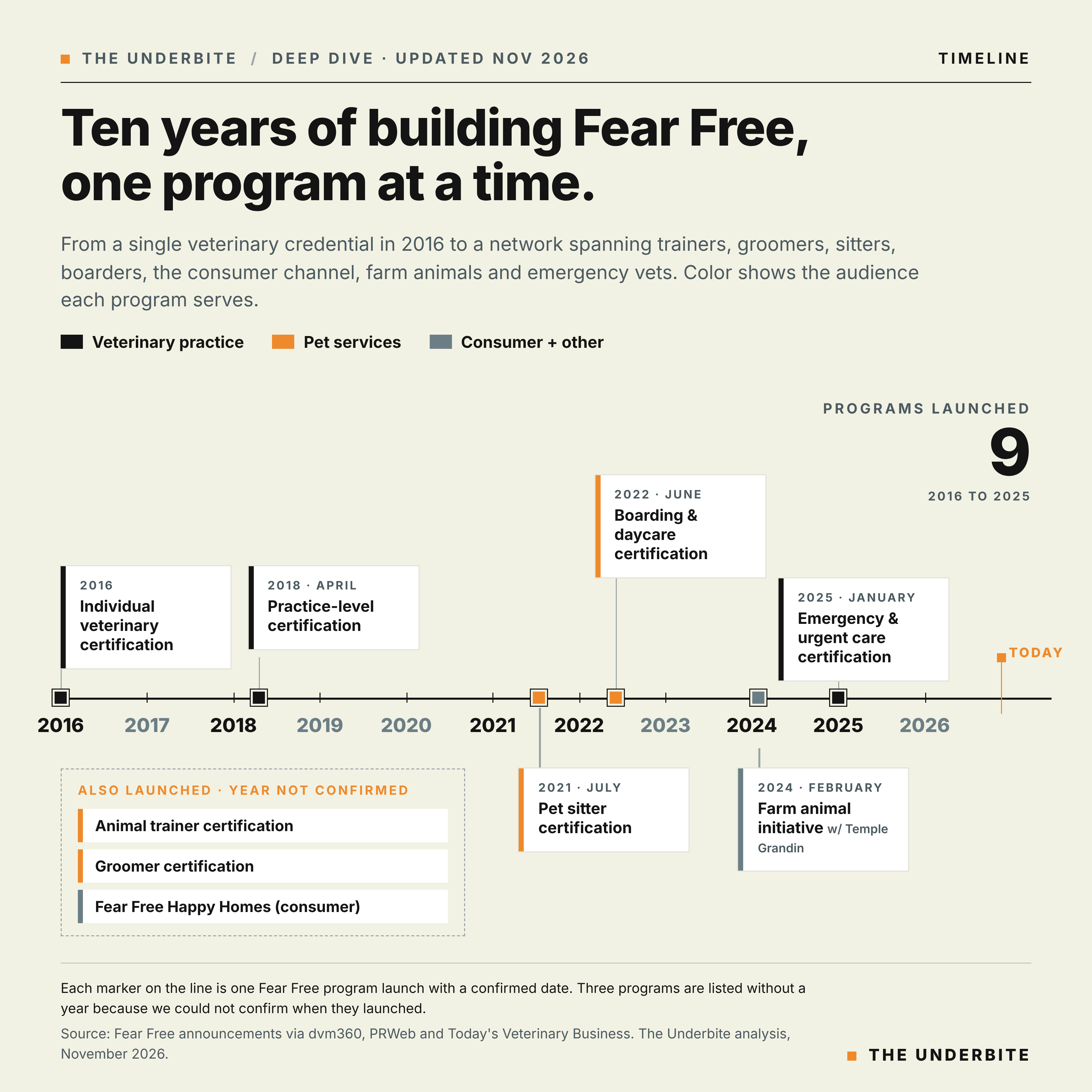
Data behind the chart: Fear Free program launches
- 2016: individual veterinary certification
- April 2018: practice-level certification
- Year not confirmed: animal trainer certification, groomer certification, Fear Free Happy Homes (consumer)
- July 2021: pet sitter certification
- June 2022: boarding and daycare certification
- February 2024: farm animal initiative, working with Temple Grandin
- January 2025: emergency and urgent care certification
Fear Free has also moved into veterinary school requirements. In 2019 the University of Florida's Maddie's Shelter Medicine Program became the first academic program to require Fear Free certification. Since summer 2022, Ross University School of Veterinary Medicine has included it in the curriculum for all students.
That's the structural marker most operators don't see.
When the institutions training the next generation of veterinarians fold a methodology into their required curriculum, the methodology is no longer optional.
Behind the scale, the leadership has changed too.
The founder has stepped back from day-to-day operations while remaining involved as Chief Professional Relations Officer. Fear Free named Randy Valpy CEO in June 2023.
Doug Korn succeeded him in 2025, the same year Civitas Growth Partners made a minority growth investment in the company.
That puts Fear Free into a familiar pattern across pet care. Founder-built organization reaches scale. Professional CEOs take over. Outside capital comes in.
An operator runs the next phase. The PE-era inflection in pet care has its own set of conversations, but the substance underneath the brand is the part worth paying attention to.
What the five-year injury study actually claims
In April 2026, Certified Safety Training, which describes itself as an independent workplace safety firm, released a 5-year analysis of injury rates at 53 Fear Free Certified veterinary practices and 29 non-certified comparison practices.
The study examined self-reported workplace injury data from 2020 through 2024. Participation was voluntary and the findings have not been independently replicated.
The numbers were striking.
Fear Free Certified practices reported:
22% fewer overall workplace injuries
24% fewer animal bites and scratches
52% lower rate of professional liability claims than non-certified peers
A few caveats are worth keeping in mind. The study is observational, not experimental.
Practices willing to pursue any kind of certification tend to already be better-run than peers that don't, which means part of any positive finding reflects that pre-existing quality rather than the certification itself.
Animal handling protocols are one variable in a system that includes reporting culture, staffing levels, training cadence, and ownership structure.
The findings should be read as a directional signal rather than proof of causation.
This isn't the first time Fear Free's outcomes have been measured.
A 2021 three-year study by VetSuccess, a veterinary data and analytics firm, looked at 41 Fear Free Certified practices and found:
13.8% increase in patients per practice
43.7% increase in canine forward booking
37.5% increase in feline forward booking
A separate 2020 survey of 1,429 Fear Free Certified professionals showed:
86% reporting an increase in client visits
82% reporting revenue growth
93% reporting an increase in workplace safety
Different methodology, different time window, same directional pattern as the CST findings.
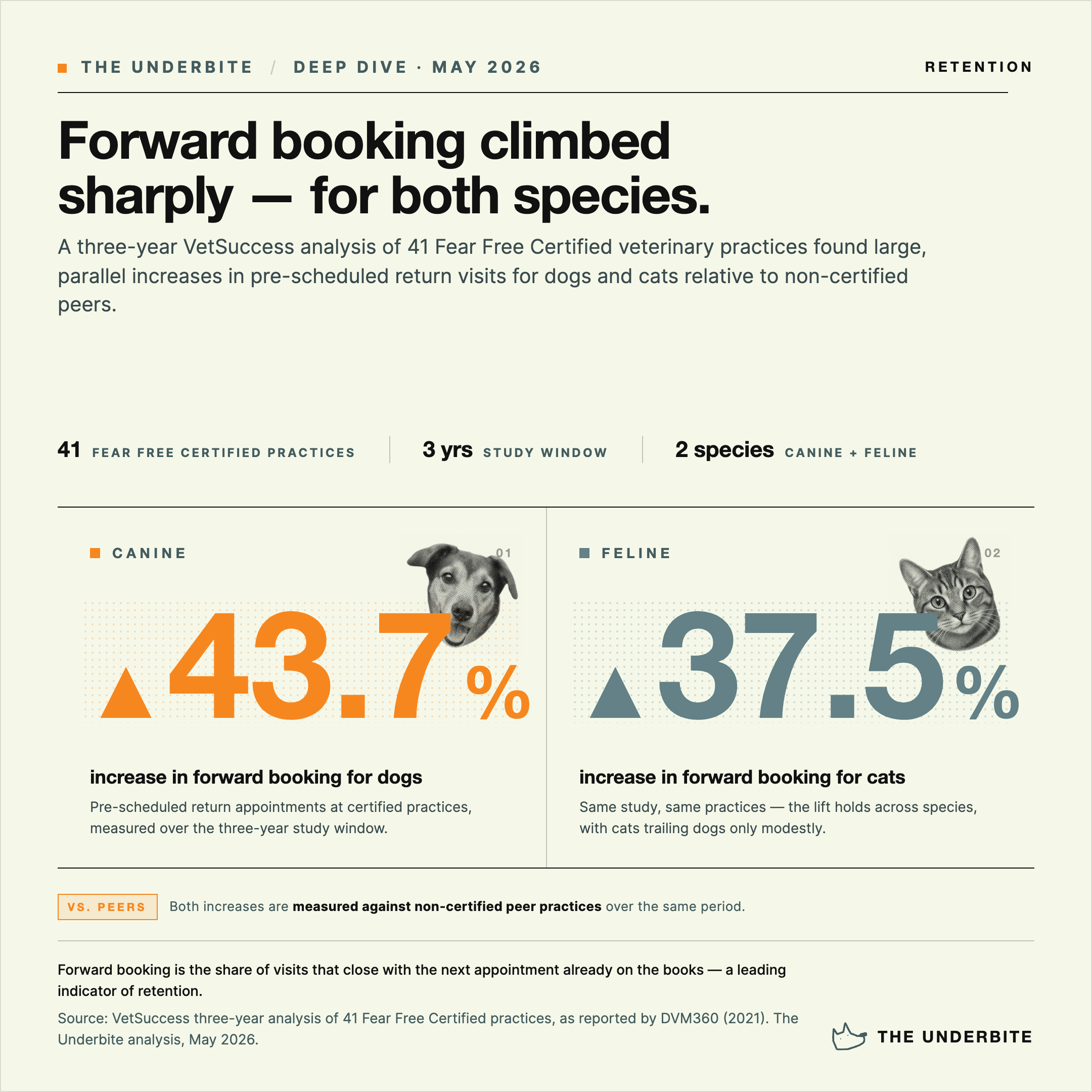
Data behind the chart: VetSuccess three-year study of 41 Fear Free Certified practices
- Canine forward booking: up 43.7%
- Feline forward booking: up 37.5%
- Patients per practice: up 13.8%
The operational context gives the numbers weight.
Veterinary medicine sits among the most dangerous fields in healthcare.
The Bureau of Labor Statistics tracks workplace injury rates in veterinary services at more than four times the U.S. workplace average.
According to HUB International data cited by DVM360, animal-related injuries account for about 70% of workers' compensation claims in the field.
AVMA PLIT's primary carrier handles roughly 3,200 claims a year, at an average cost of $2,700 each in HUB data for 2015 to 2018.
In a profession where replacing an employee can cost 1.5 to 2 times salary (Gallup, cited by AAHA) and a credentialed technician role takes almost 13 months to fill, per AAHA's retention survey, fewer injuries means fewer disrupted weeks, fewer claims to manage, and fewer reasons to leave.
CEO Doug Korn's framing of the logic, from an interview with The Underbite, is straightforward.
"Fear Free is often introduced as a way to improve the patient experience, but what this data shows is that it also functions as a practical risk-reduction strategy. When patients are calmer, procedures are smoother, and that directly reduces the situations that lead to injuries, claims, and disruptions." Doug Korn, CEO, Fear Free
Whether the study's specific numbers hold up under independent replication is a question for the next round of research.
The broader argument they support has been visible to veterinary operators for a decade.
Calmer patients drive better operational outcomes.
Better operational outcomes show up on the workforce side of the P&L.
What makes Fear Free's scope structurally different
Several other organizations do rigorous work in pet care certification, each in its own scope.
The American Animal Hospital Association runs the most comprehensive veterinary practice accreditation in North America, with on-site evaluation against a set of standards that includes nearly 50 mandatory ones, and only about 15% of practices hold it.
The Cat Friendly Practice program has a peer-reviewed outcome study behind it, a 2023 paper in the Journal of Feline Medicine and Surgery showing higher diagnostic testing, 17% higher revenue per visit, and higher visit volumes at certified practices.
The Certification Council for Professional Dog Trainers runs an independent certification program for dog trainers.
The Low Stress Handling certification from CattleDog Publishing has built a community of certified professionals across more than 30 countries.
Each of these does excellent work in its own scope.
What's structurally different about Fear Free is the breadth.
A single curriculum and behavioral standard spans veterinary medicine, grooming, training, boarding, pet sitting, and consumer education.
That cross-vertical scope is the part most operators outside veterinary medicine misjudge.
For a small or mid-sized grooming salon competing against five other shops within a ten-mile radius, the question of how to differentiate is the single most common pain point.
Same for a regional boarding operation.
Same for a trainer trying to build a referral network.
Most pet service businesses respond by buying more social media ads, refreshing their website, or doubling down on the same marketing buzzwords that operators and consumers have already learned to discount.
None of which solves the underlying differentiation problem.
The structural alternative is to align with an established educational program and the credential that comes with it.
Fear Free is one of the few available outside the vet clinic that operates across multiple service verticals.
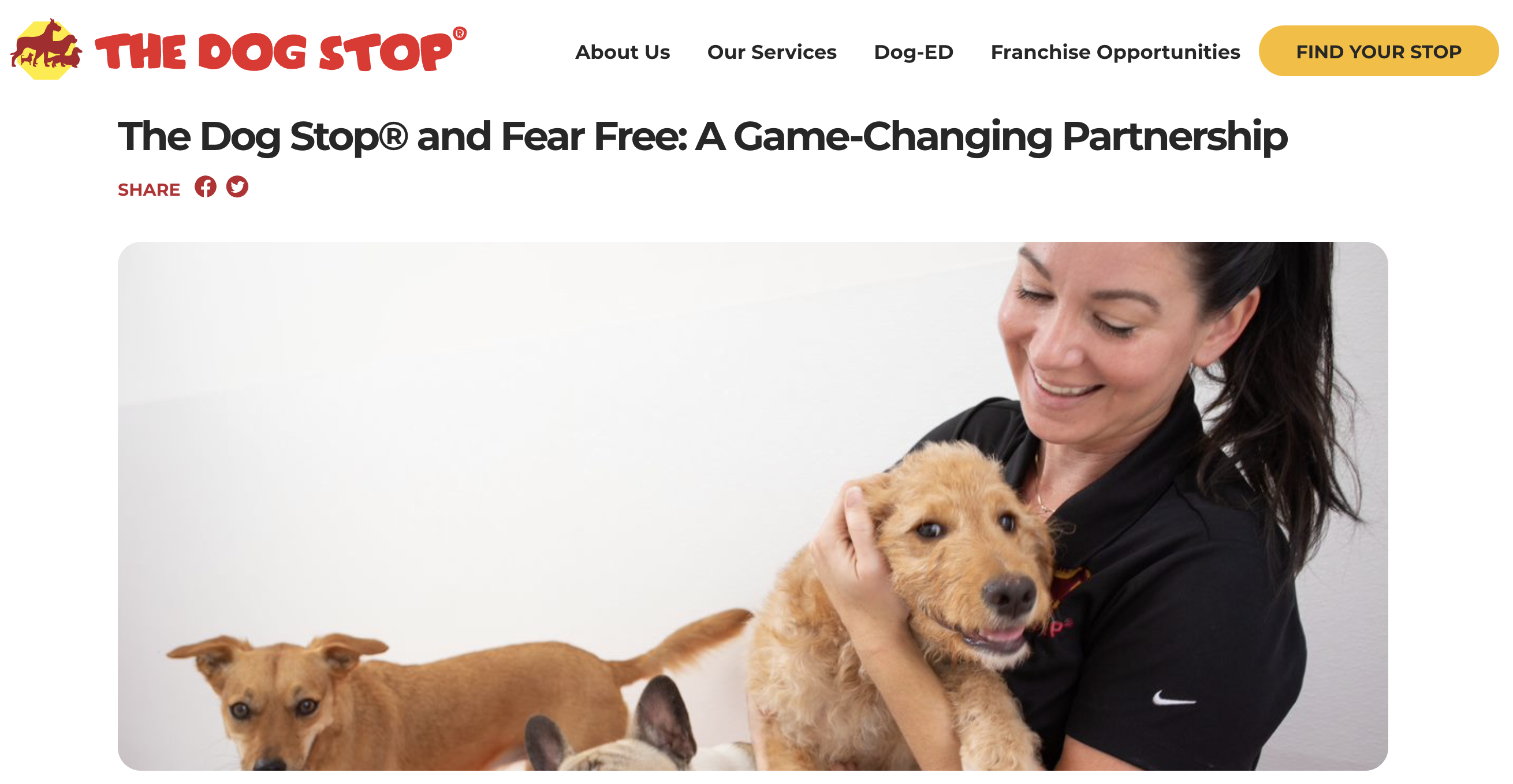
Pet parents can also meet it through the Happy Homes channel.
For a small business, team certification is a training cost paid up front, and the credential keeps working long after a campaign budget runs out.
Korn put the logic in operational terms during the interview.
"It's not an added step. It becomes the standard."
For operators across the gradient of pet care, the implication is that the marketing function and the operations function start to look like the same thing.
The harder problems waiting in decade two
Fear Free said in 2026 that its plan runs on three tracks.
The first is curriculum expansion.
It said it would add more than 80 new hours of continuing education to the library in 2026, with new modules covering feline and senior pet health, communication, mental health, professional development, and burnout prevention.
The second is access.
The company has simplified its practice certification pathway to lower the lift for small and mid-sized clinics.
The third is ecosystem.
Weekly webinars, short-form video, written resources, and an active member community are designed to keep professionals engaged with the education long after initial certification, treating it as an ongoing relationship rather than a one-time exam.
The retention story is implicit in the roadmap.
Veterinary medicine's labor crisis has been visible for years.
A CDC-led analysis published in JAVMA found veterinary suicide rates running roughly 2 to 3.5 times the general population, and recent industry surveys show serious psychological distress in the field remains elevated.
Building professional development and mental health into a clinical curriculum is not a soft proposition for a practice owner.
The harder question, and the most interesting one for the next decade, is whether the same data-backed credibility Fear Free is building inside veterinary medicine extends across the rest of pet care.
The vet world has a peer-reviewed predicate to build on, the published literature on handling and welfare, and a growing body of operator data on outcomes.
Grooming, training, boarding, and sitting do not. Building the equivalent body of independent evidence in those verticals is the structural work of the next ten years.
If Fear Free pulls that off, it ends up as something pet care has not had before.
A single behavioral standard with definition, accreditation, and outcomes data across every consumer-facing surface in the industry.
That’s what holds up over time.
And it is the part operators reading this should be paying attention to whether they sell food, groom dogs, run a boarding facility, or own a vet practice.
Why the pattern matters beyond Fear Free
There is a broader argument underneath the Fear Free story that travels well outside any single organization.
Pet care is a fragmented industry running on a lot of tacit knowledge. Handling techniques in muscle memory.
Customer-service norms passed shop to shop. Business practices that vary wildly between independent operators and corporate chains.
Industries that mature tend to codify what their best practitioners already do, turning that knowledge into curriculum, certification, and a shared body of evidence.
The verticals in pet care where that codification has happened (veterinary specialization, food safety, professional dog training) are the ones operating at higher trust and higher margins.
Fear Free has spent the last decade doing that codification work for animal behavior and handling, first inside veterinary medicine and then across grooming, training, boarding, pet sitting, and consumer education.
Whether it continues to extend that infrastructure across the rest of pet care is a function of how seriously the company invests in independent validation, transparent methodology, and external outcome data over the next five years.
The operators most likely to benefit are the ones who recognize what the organization has become rather than what the language around any single certification might suggest.
A decade ago, Fear Free was an educational argument about animal welfare.
Today it is operational infrastructure with several industry-run outcome studies, cross-vertical coverage, an outside growth investment behind it, and a roadmap that reads less like a passion project and more like a platform.
The next ten years will decide whether the rest of pet care follows the curve.
Keep reading
- Why vet clinics don't post prices, and who is changing that
- 55% of surveyed vet techs say their skills go unused
- Ivan Zak on turning veterinary burnout into a business mission
Cite this: The Underbite, "Fear Free at 10: How Low-Stress Handling Became Pet Care Infrastructure," May 20, 2026. Updated November 14, 2026. https://www.theunderbite.co/health-vet-care/fear-free-certification-10-years
Affiliated Products
Lorem ipsum dolor sit amet, consectetur adipiscing elit. Suspendisse varius enim in eros elementum tristique. Duis cursus, mi quis viverra ornare, eros dolor interdum nulla, ut commodo diam libero vitae erat.