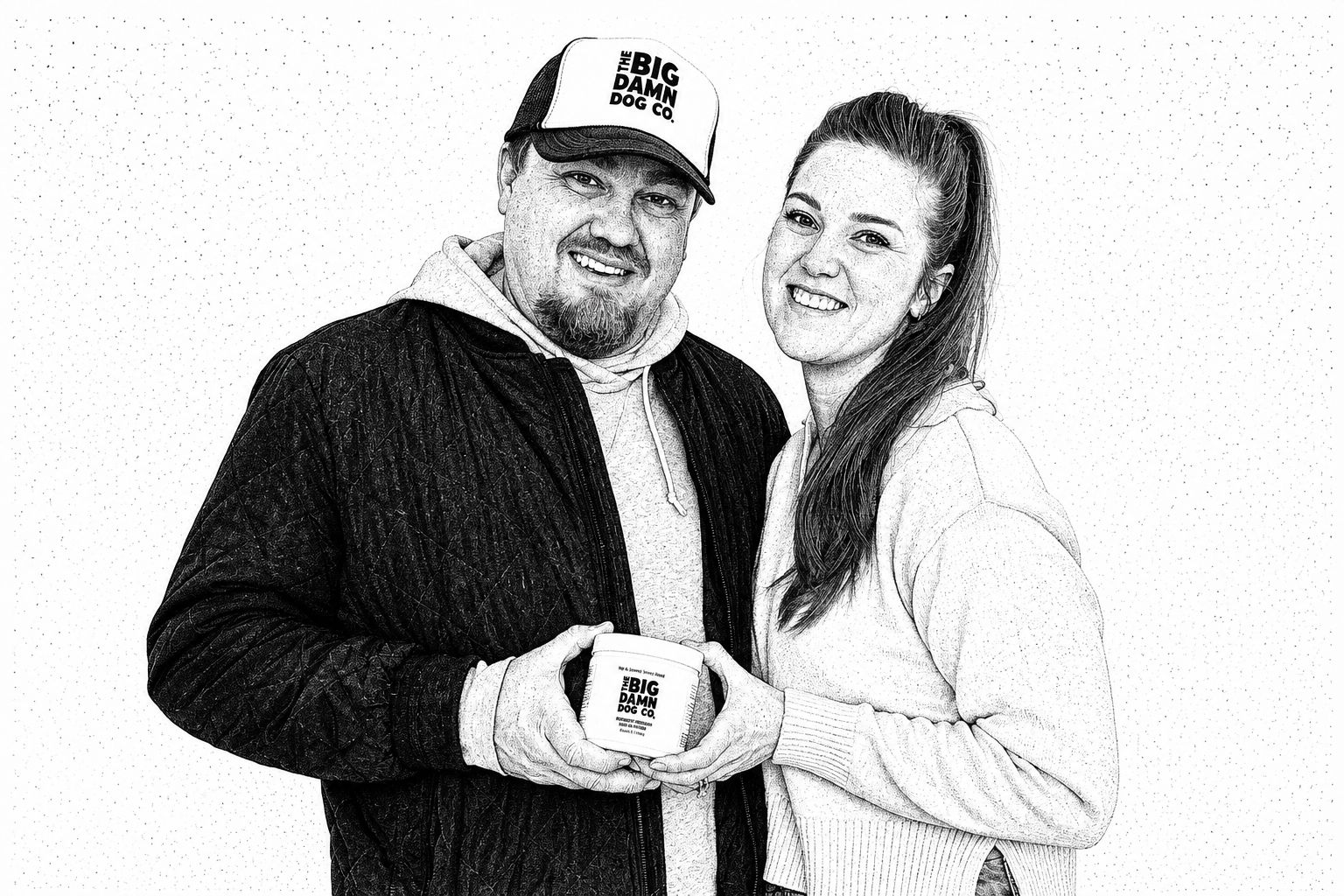
Sarah McLean | Co-Founder & CEO, Big Damn Dog Co.
A joint supplement label that stopped at 60 pounds sent Sarah McLean looking for a product that did not exist. Big Damn Dog Co. is the bootstrapped answer: giant-breed formulations, dosing built for 120-pound dogs, and a customer list the founders still call by phone. Six months after launch, its Gravy Blend already accounts for roughly 40% of joint supplement sales.
For most dog owners, joint supplements are pretty straightforward: check the label, find your dog’s weight, and follow the recommended dose. But when Sarah McLean brought home Lucy, her 120-pound Great Dane, she quickly realized that system wasn’t built for dogs like hers. The supplement her veterinarian recommended had one instruction for every dog over 60 pounds. Lucy weighed twice that. Was one chew enough? Should she double it? And how could she know whether either option was actually effective?
That problem became Big Damn Dog Co., a brand built specifically around the health needs of giant breeds. Today, Sarah and her husband Jared McLean are building beyond their original joint supplement, with a fast-growing Gravy Blend and a bigger ambition to become the go-to brand for giant-breed health, education, and eventually everyday life.
We spoke with Sarah about bootstrapping the business, why giant breeds remain underserved, building DTC, listening closely to customers, and what it will take to turn a niche supplement company into “The Giant Breed Brand.”
Big Damn Dog Co. started with your own Great Dane and a problem you couldn’t find a good solution for. What was missing from the market, and when did you realize there could be a business here?
It started at a vet visit.
After we adopted Lucy, we took her in to establish care, and our veterinarian made it clear how important it was to start joint care early for giant breeds. So we bought the product she recommended most highly.
Then I turned the bottle around and read the dosing instructions: For dogs 60 pounds and over, give one chew.
Lucy was 120 pounds.
So what was I supposed to do? Double it? How could I know whether she was getting enough, whether I was giving her too much, what was safe for her, or what would actually be effective?
I just wanted to do right by her, and the label couldn’t tell me how.
That was when we started to understand how overlooked giant breeds had been. This was in 2020. We looked across the market and couldn’t find a single product that was actually formulated and dosed for a dog Lucy’s size.
At the time, I worked for a supplement company, so I understood what it took to develop custom formulations. That combination of experience and the problem we were facing helped us recognize that there was a genuine need we could fill.

Where did the name Big Damn Dog Co. come from?
It came from life with a giant dog.
I’d be out walking Lucy, and people would say to me: “Wow, that’s a big damn dog.”
So when we sat down to brainstorm a name for the business, that was already top of mind. It was already the thing people said out loud when they met one of these dogs.
It just fit. That’s real life with these dogs.
And it makes it obvious who we’re for. We’re the big dog company. We’re here to do right by these dogs and their humans.
Education seems to be a big part of the brand. What are some of the biggest misconceptions owners have about giant breeds, and how does education ultimately help you sell the product?
Maybe one of the biggest misconceptions is one I will fight to my dying breath: that giant breeds are couch potatoes.
That stereotype is actively harming them. No dog is meant to be sedentary. Just because a big dog can sleep all day doesn’t mean they should. When owners accept inactivity as normal for these breeds, it will only contribute to more health problems and complications long-term.
Another misconception is the belief that pain and limited mobility are simply inevitable. Big dogs slow down early. They limp before they become seniors. Owners often brace themselves for that as though there is nothing they can do about it.
There is so much more within our control, or at least within our influence, than many owners realize.
And in looking at the bigger picture, I think one of the biggest realities giant breed owners have to face is that these dogs live life on fast-forward. Their lifespans are shorter. That means those decisions we make about their health and care matter even more.
I get passionate about education because these dogs cannot advocate for themselves. The more we can help owners understand what it actually looks like to care for giant breeds properly, the better those dogs’ lives can be.
And yes, there’s a real connection between education and how that converts to sales.
I’d argue it’s a prerequisite now. We live in a world where information is so readily available. You owe it to your audience, your community, and your potential customers to demonstrate your competency.

In an era of chatbots and AI agents, you actually spend a lot of time talking directly to customers through email, postcards, and even phone calls. What have those conversations taught you, and how have customers responded to that personal approach?
We reach out and engage with our customers a lot, especially in the beginning.
The reality is that, with a supplement, we are impacting an animal’s health. To us, that is a serious matter. We want to hear how it is going, and we want to know if there are any challenges.
It is just as important for us to hear when the product is not working as when it is. That feedback tells us whether there is something we have overlooked or a specific kind of condition our product does not work for. Anything we can learn is going to help us better serve more big dogs in the future.
It is also really fun.
E-commerce has a lot of upsides, but one of the downsides is that you never get to meet the people on the other end of the shipments you send out. In our case, that means the people and the dogs.
These conversations let us meet them. They ground the work we do, and the impact we can have, in real dogs.
It is incredibly meaningful to learn that Todd, a Great Dane in Texas, got his zoomies back because of our product, and that his mom, Jennifer, shares my passion for houseplants and doing absolutely anything for our furbabies.
Those conversations have given us invaluable insight into our product and how it fits into the real world. The customers I have had the chance to speak with have been incredibly appreciative of that personal touch and of being treated like a human.
No one is a number to us. They are a name. And they are a dog whose life we are hoping to change.
You’ve bootstrapped the company so far. What’s been the thinking behind that decision, and how has staying bootstrapped shaped the way you’ve built and grown the business?
Maintaining ownership of the company for the long term is what guided that decision in the beginning.
Having 100% control and being able to create something that was fully ours was very appealing. We are not against exploring alternative routes in the future, but right now, staying bootstrapped is what allows us to bring our vision to life exactly how we see it.
It has forced us to be creative and stay lean, and allowed us to pivot quickly.
At times, the trade-off of slower growth can be frustrating. But doing so has also allowed us to remain 100% focused on our customers and the problem we are here to solve, without the noise of loans or investor milestones.
Your Gravy Blend already makes up roughly 40% of joint supplement sales just six months after launch. Did you expect it to take off that quickly? What has that taught you about what your customers actually want?
As soon as the idea formed in my mind, I remember telling my husband, “I think this is going to be big.”
It was just such a different way to approach joint care that I knew, to some degree, it was going to be a hit. Did I expect it to become that big of a hit that quickly? No. But I am thrilled.
We heard a lot of caution while creating our Gravy Blend, only our second product. “You do not want to cannibalize your flagship product...” “You are building something that could compete with it...”
What I kept coming back to was: So what if we do?
I never want to be attached to the product I make. I want to be attached to the problem I made it to solve. And I do not want to be afraid to innovate, even if it means disrupting ourselves.
Our Giant Breed Hip & Joint Chewable Tablets were our first product. They are what we launched the company with and what we built the company around for two years. But the number one reason people left us was that their dogs would not eat the chews.
Now, 6 months in, we’ve had current customers switch from the Tablets to the Gravy, come back and order the Gravy after cancelling the Tablets, and new customers entirely who see the benefits the Gravy has to offer. And yes, we still have plenty of dogs who love the Tablets too!
The goal was never to simply sell more chews. It was to serve more dogs. These two products (or rather, two variations of the same product) allow us to do just that.
I think it is easy to get caught up in innovation for innovation’s sake. The Gravy Blend came from genuine feedback from our customers, especially those with picky eaters who needed the supplement but would not take it.
It really was that simple. It was not about creating something brand new. It was about improving the delivery of something we already knew worked.

You’re currently entirely direct-to-consumer. Why has DTC been the right model for the business?
We’re a startup company that created a product that had never existed before. DTC has allowed us to have that feedback loop with our customers.
We hear directly what’s working and what’s not. And that has allowed us to make a better product and deliver a better experience.
Selling off a shelf, you lose that ability to connect with your customers. To learn their dog’s name. To hear how they’re doing.
Wholesale has its own pros and cons, and it’s on our radar for the future. But for the phase of business we’re in right now, DTC gives us that connection. And it allows us to make the biggest difference for these humans and their dogs.
What does your customer acquisition funnel look like today? Where are people discovering you, which channels actually convert, and what have you learned about turning a big-dog owner into a customer?
It’s a bit of a toss-up as to which funnel performs best. Truly, it varies.
We can blame that on the algorithm. One month one will hit; the next month it’s a different one. So it’s a constant puzzle to address and tweak.
We run paid ads through search engines and Meta, alongside awareness campaigns and a lot of organic content. And we have a growing network of affiliates and industry referral partners.
That was a big learning curve — figuring out where our ideal customers already are, and how we then get in front of them. So much trial and error. With the algorithms changing as quickly as they do, it can be a maddening puzzle to try and solve.
What we’ve found is that it comes down to staying consistent with our messaging and giving a big dog owner a variety of angles to understand what may be missing from their current joint care. Or why they should have joint care in the first place.
Because we do still have to do a large amount of educating.
Too many owners wait for their dog to start showing symptoms before they start a joint care routine. When, as my vet educated me, the very best thing you can do is start a supplement routine before any issues ever arise.
So that’s an element we focus on quite a bit — problem awareness content as much as anything else.
You’ve said you want Big Damn Dog Co. to become the go-to place for all things big-dog related. What does that ultimately look like, and how do you get from a supplement company to that bigger vision?
Our vision is to become The Giant Breed Brand™ — the new standard of care in giant breed wellness.
These big dogs have been so misunderstood for so long. So many owners don’t realize their dog isn’t just a bigger version of other breeds.
And I say that having been one of them. Before Lucy, my first Great Dane, I was incredibly ignorant of the unique health challenges she would face and what life with her would look like.
So we want to make that evolution - from ignorant to educated - as easy as possible.
Not everyone is going to be me. Not everyone is going to spend hundreds of hours researching the right food and the right supplements and all of these things about their care. If we can take that and package it so an owner becomes competent in the areas that make the biggest difference to their dog’s long-term health, that’s how we raise the standard of wellness for giant breeds.
We also want to make it easier to find stuff.
We know how hard it can be to find collars and leashes and harnesses and beds that actually fit and are sized for these big dogs. And when you can find them, they come in one of two ugly colors. We want to bring all the personality and the fun of having a dog to giant breeds as well.
We’re beginning on the health side of things because that’s our background. It’s what we know and what we’re most passionate about. Long-term, we’d love to expand into all areas of lifestyle with them — apparel, accessories, tools — and really become a one-stop shop for everything you need for life with these big dogs.
How do we get there? Time and focus.
We’ve got that BHAG - big, hairy, audacious goal - marked out in our future. We know where we’re headed.
Right now we’re still solving health needs. We want to expand into other supplements that are challenging to find dosed for giant breeds. We want to take care of their health first. We’ll get into the fun stuff later.
But we have that vision for the company, and it’s very clear. We have the health arm. We have the education arm. We have the community arm. We’ll get to the lifestyle arm as those others fill out.

What has been the hardest part of building Big Damn Dog Co. that you didn’t anticipate when you started?
Becoming the person the business needed me to be.
Entrepreneurship is humbling. It’s the most intense personal development out there.
I’ve always enjoyed the game of business. In most of my jobs, I ended up in an Operations role, and I really enjoyed the high-level business building — the strategy and implementation, the innovation, making all the systems work together. That’s all very natural for me. So being able to take that and apply it to something that is our own felt like a real privilege.
But looking back, I’ve predominantly worked in service-based businesses. Customer service and that in-person element is what I knew.
E-commerce is its own beast. It’s entirely different.
I think that’s why, when you look at the structure of our business, you see a lot of service built into it. We call all of our customers. We send them postcards. Because that relationship is what I know.
That’s a tangible example of being out of my depth and having to learn an entirely new approach. But I think it’s also allowed our e-commerce business to look different than it might have without that past experience.
So — becoming the person the business needs me to be, at each phase.
It’s so hard. It’s relentless. It can be lonely. Isolating. There are pits of despair in between the peaks of the wins. And then you get that win, and the business needs someone new again.
Other Interviews
More conversations with founders, operators, and investors building the future of pet care.