China Now Designs Most of America's Pet Hardware
We pulled more than 22,000 US pet patents. In 2025, 78% of new pet design patents named an inventor in China, up from 7% in 2015. Here is what that means for feeders, fountains, litter boxes and the 90+ big-brand patents that expire by 2028.

Key findings
- In 2025, 865 of 1,111 US design patents for pet products (78%) named an inventor in China, up from 12 of 176 (7%) in 2015.
- Through early October 2026, the China-linked share fell to 69%, from 79% for the same dates in 2025. It is the first drop in a decade.
- China-based inventors appear on 71% of US feeder and waterer patent filings, 53% of litter box and pet housing filings and 53% of toy filings (filed 2022 to 2024).
- 55% of China-linked pet design patents granted from 2023 to 2025 claim micro entity status, against 23% of all other pet design patents.
- More than 90 active utility patents from big pet and animal health companies have estimated expiry dates in 2027 and 2028.
How we know: The Underbite analyzed more than 22,000 US pet patents and applications filed since 2001, with data through early October 2026.
The automatic feeder built into the butcher-block kitchen island. The water fountain gurgling by the back door. The litter box in the hall closet that cleans itself, then texts you about it.
There’s a good chance someone in Shenzhen drew up the designs for all three.
Ten years ago, the US granted 176 design patents for pet products. 12 of them named an inventor in China. In 2025 the US granted 1,111, and 865 named an inventor in China.
That’s 7% to 78% in a decade.
Those 865 designs are protected until 2040. Each one locks up how a feeder, a fountain or a litter box can look in the US market for the next 15 years.
We pulled every US pet patent and application filed since 2001, more than 22,000 of them, to see where the industry’s ideas actually come from. The China number practically punched us in the face.
We count a design as China-based when at least one inventor lists an address in China. Ownership is a separate record.
So far in 2026, the China share looks to have fallen for the first time in a decade.
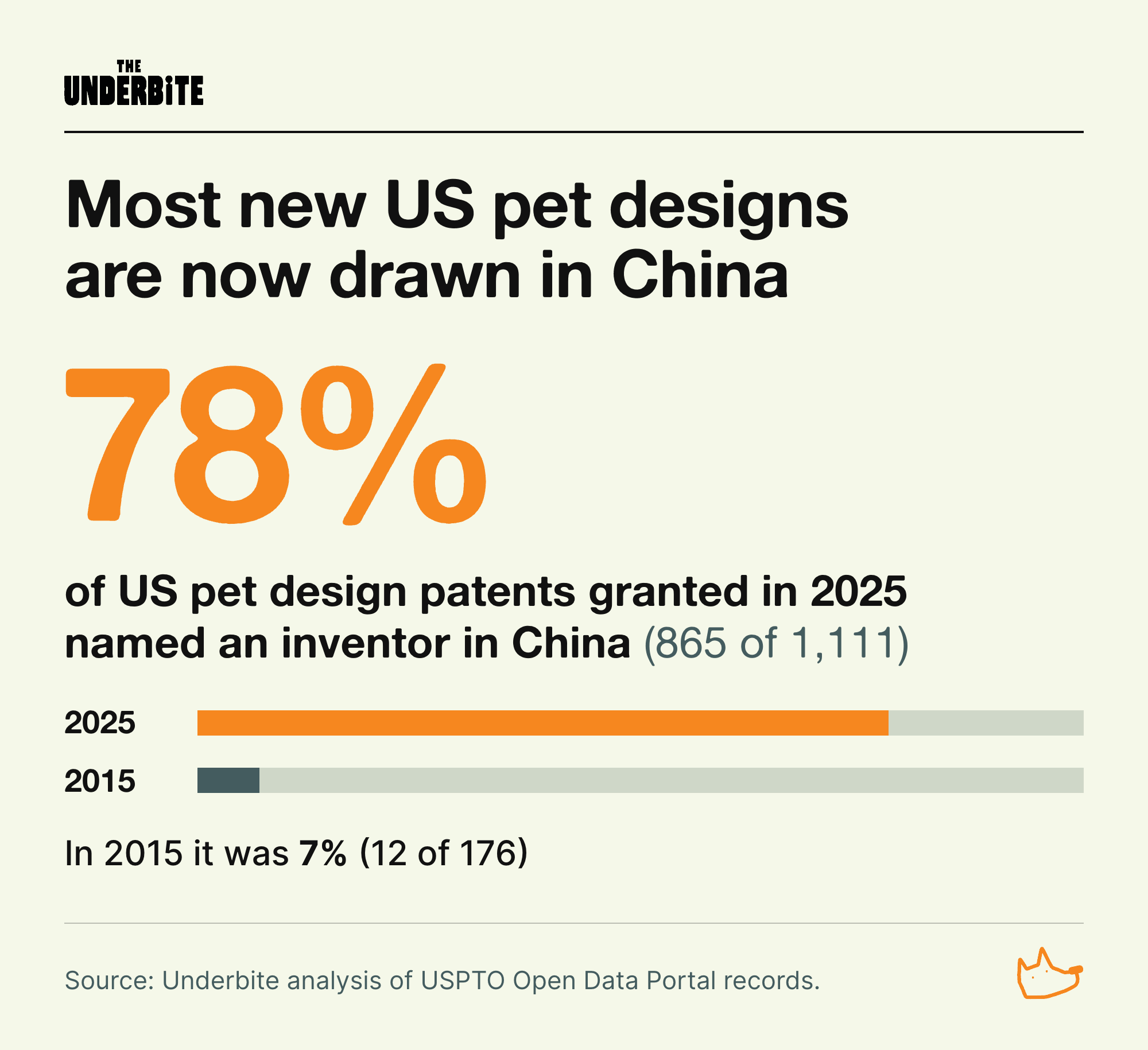
Data behind the chart: US pet design patents naming a China-based inventor
- 2015: 12 of 176 (7%)
- 2025: 865 of 1,111 (78%)
Pet design runs at nearly twice the China rate for all US designs
This isn’t only a pet story. China-based inventors gained ground across the whole US patent system. Their share of all US design patents went from 4% in 2015 to 41% in 2025.
Pet just got there faster and went further.
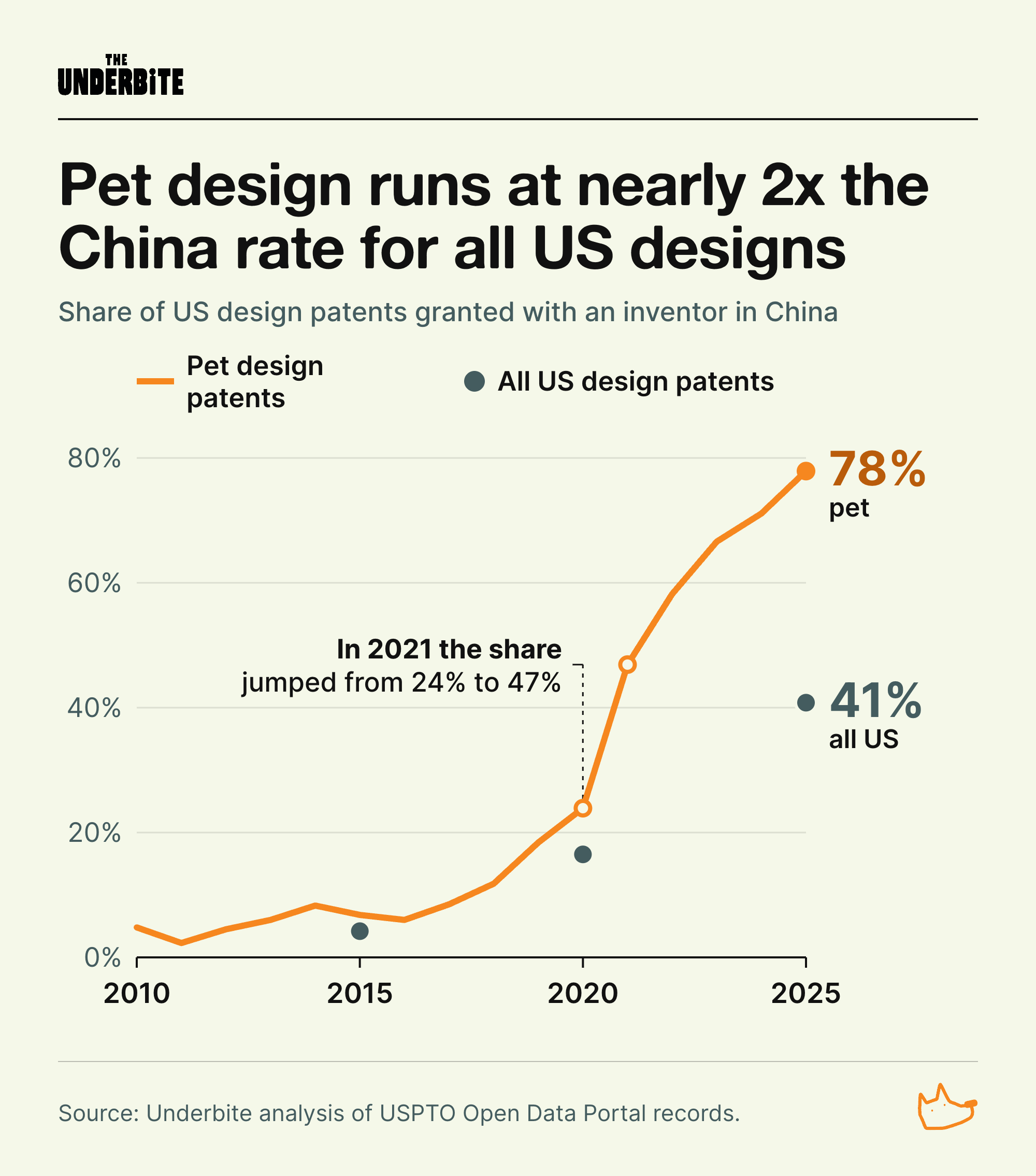
The break came in 2021, when the pet share jumped from 24% to 47% in a single year. From 2021 to 2025, a China-based inventor appears on 68% of every pet design the US granted, 2,367 of 3,502. Over the full decade, China-linked designs account for 91% of all the growth in pet design patents.
Ownership is following the same path. In 2015, under 2% of pet design grants listed a China-based owner. In 2025 it was 47%.
2026 is the first year the share slipped
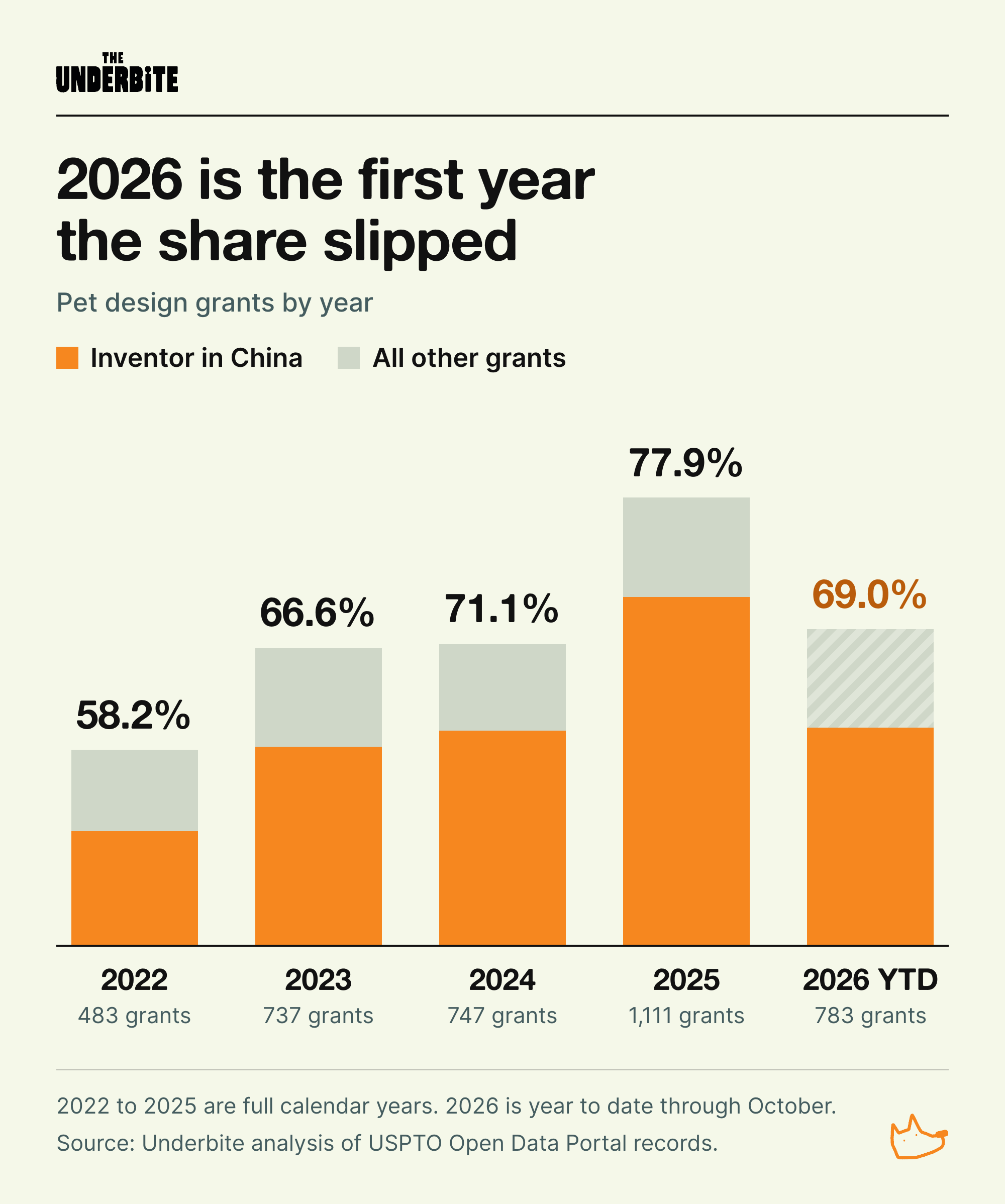
Data behind the chart: US pet design grants, early October year to date
- 2025: 79% China-linked (692 China-linked, 180 other)
- 2026: 69% China-linked (540 China-linked, 243 other)
Through early October 2026, 69% of new US pet design patents named a China-based inventor. For the same dates in 2025, it was 79%.
The China-linked count fell from 692 to 540. Everyone else went the other way, from 180 design grants to 243, up 35%.
Nine months is a short window, and USPTO examination backlogs push these counts around. Designers outside China collected 246 pet design grants in all of 2025. They already had 243 by early October 2026, with a quarter of the year still to go.
The newcomers keep coming too. 262 of the 555 owners with a 2026 pet grant had no pet patent record before 2024. Two-thirds of them list a China-based inventor.
That timing lines up with TikTok Shop, which opened in the US in late 2023. We can’t prove one caused the other. But a feeder that demos well in a 15-second video is exactly the kind of product a first-time filer wants to protect.
Most new feeders, fountains and litter boxes are designed in China
The more moving parts a product has, the higher the China share climbs. On pet patent filings from 2022 to 2024, a China-based inventor appears on 71% of feeders and waterers, 53% of litter boxes and pet housing and 53% of toys.
Pet food sits at 3% and vet drugs sit at 5%.
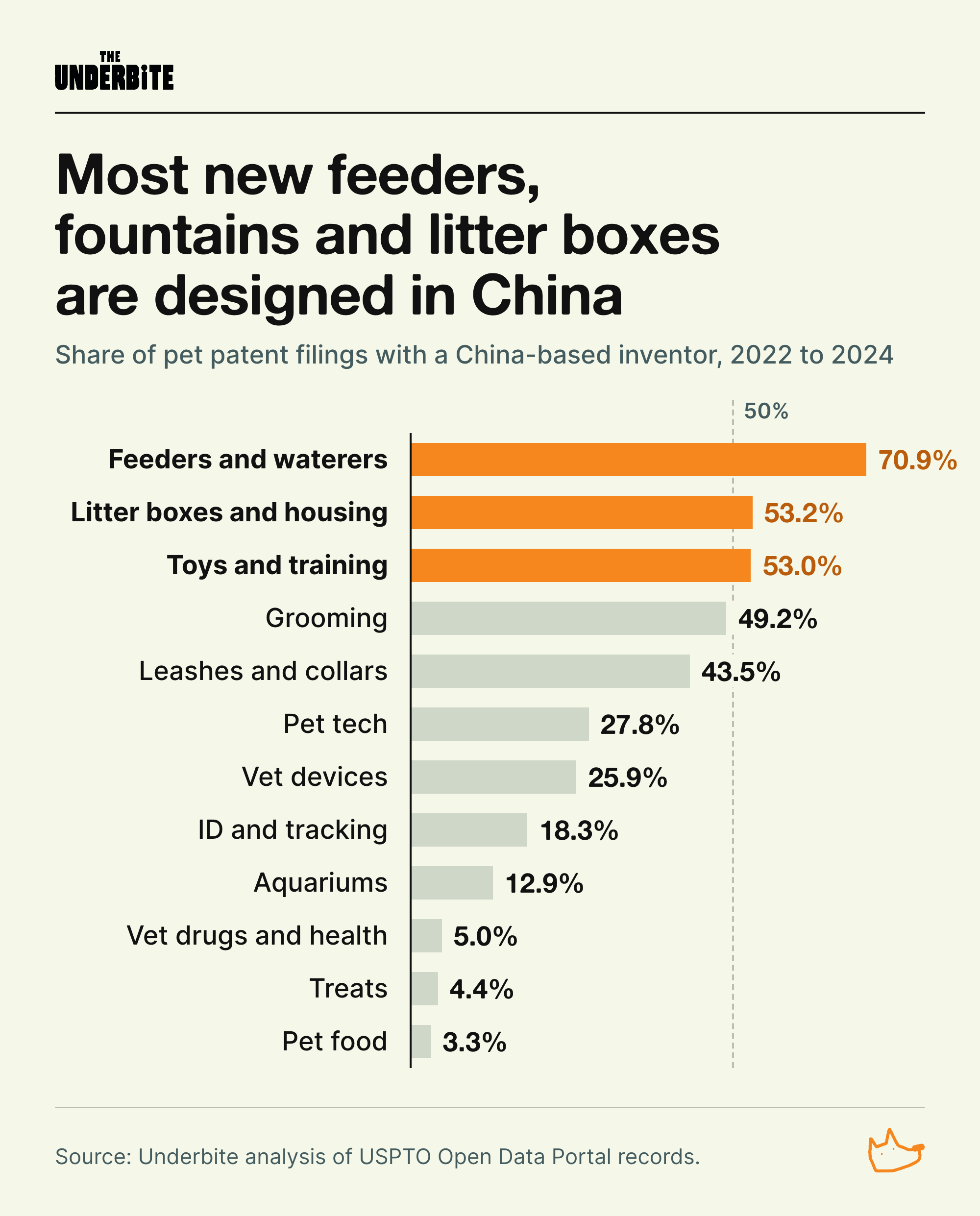
Data behind the chart: share of pet patent filings naming a China-based inventor, filed 2022 to 2024
- Feeders and waterers: 71%
- Litter boxes and pet housing: 53%
- Toys: 53%
- Vet drugs: 5%
- Pet food: 3%
Most of the top filers are names few US buyers would know, like Shenzhen TIZE Technology and Zhejiang Arru Pet Products. One they would know is Petlibro. The smart feeder brand landed in more than 300 Target stores in 2024 and launched a litter box at PetSmart in March 2026. Its US trademarks belong to Shenzhen Libro Technology.
These patents last a long time and cost very little to hold. A US design patent runs 15 years from grant with no maintenance fees.
Fee discounts help. 55% of China-linked pet design patents granted from 2023 to 2025 carry micro entity status, the USPTO’s smallest-filer tier with an 80% fee cut. Among all other pet design patents, it’s 23%. At the micro rate, the four core design fees total about $520, a fifth of what a large company pays.
The USPTO has started policing that tier. In October 2024 it terminated about 3,100 applications tied to misused micro entity forms, and a false entity claim now carries a penalty of at least 3x the unpaid fee. Our data shows each owner’s current entity status. It says nothing about whether any single claim is valid.
Here’s why this matters to a brand selling hard goods online. Design patents are the go-to weapon in court. Kyjen, the company behind Outward Hound, used pet design and utility patents to win a $200K default judgment and an injunction against a batch of online sellers in a case that closed in April 2026.
Anyone launching a feeder, fountain or litter box in the US today is designing around a pile of patents drawn in China.
That pile landed right as cats got hot. Cat ownership jumped 23% in 2024 and grew another 5% in 2025 to 53M US households, according to APPA’s latest cat report. That’s probably not a coincidence. For plenty of US startups eyeing the cat aisle, the best-looking litter box may already be spoken for. Launch one too close to it, and the first serious conversation could be with a lawyer.
Utility patents are next
Design patents cover how a product looks. Utility patents cover how it works. They cost more and take longer, and China’s share of them in pet is following the design curve about five years behind.
Pet design hit 24% China-linked in 2020. Pet utility hit 21% in 2025, up from 4% in 2015. The count nearly doubled in a single year, from 50 grants in 2024 to 95 in 2025. Through early October 2026, the share is 23%, against 20% for the same dates in 2025.
Litter boxes lead with 30 of the 95. Toys and training gear follow with 25, then feeders with 10. Petlibro alone holds 16 US pet patents.
The abstracts read like a product teardown. Rotating shovels that sift the litter. Bins that seal the waste bag on their own. Only 2 of the 95 are pet tech.
The best-known US player is building in the same aisle. Whisker has sold more than 2M Litter-Robots and is putting more than $50M into engineering and R&D across 2025 and 2026. Its $899 Litter-Robot 5 Pro carries two AI cameras and pairs with a $7.99/mo app subscription.
Big tech is circling too. Samsung holds patents on pet care robots. iRobot holds one for a vacuum that cleans around the litter box after the cat uses it.
If I had to guess, the next round of US pet hardware fights happens over utility claims. Amazon’s fast-track patent review, APEX, only accepts utility patents and settles most cases in about 30 days.
Who drew it is not who owns it
Three caveats belong right next to the headline number.
First, inventor location is not ownership. Plenty of US brands hire engineers and design firms in Shenzhen, and those patents list a US owner. That’s why the 78% inventor share drops to 47% when you count owners instead.
Second, design patents are narrow. Each one protects a single ornamental look. Change the curve of a bowl or the shape of a lid, and a competitor can sell a feeder that does the same job. A big stack of design patents builds a fence with plenty of gates.
Third, enforcement cuts in every direction. Kyjen is a US company, and its suit targeted online sellers. Design patent suits in the Northern District of Illinois, where most of these marketplace cases land, rose from 6 in 2021 to 172 in 2024, according to Unified Patents data cited by Finnegan. And those wins can unwind. In July 2026 the Federal Circuit upheld the dissolution of an injunction a Shenzhen fan maker had won against online sellers on a design patent.
Pet food is 43% of spending and 9% of patent applications
Hard goods are where the patent fights happen. They are not where most of the spending goes.
Americans spent $158B on their pets in 2025, according to APPA. Food and treats took $68.3B, about 43%. Vet care and products took $41.0B, about 26%. Supplies and hard goods took $34.4B, about 22%.
Food and treats account for 9% of pet utility patent applications.
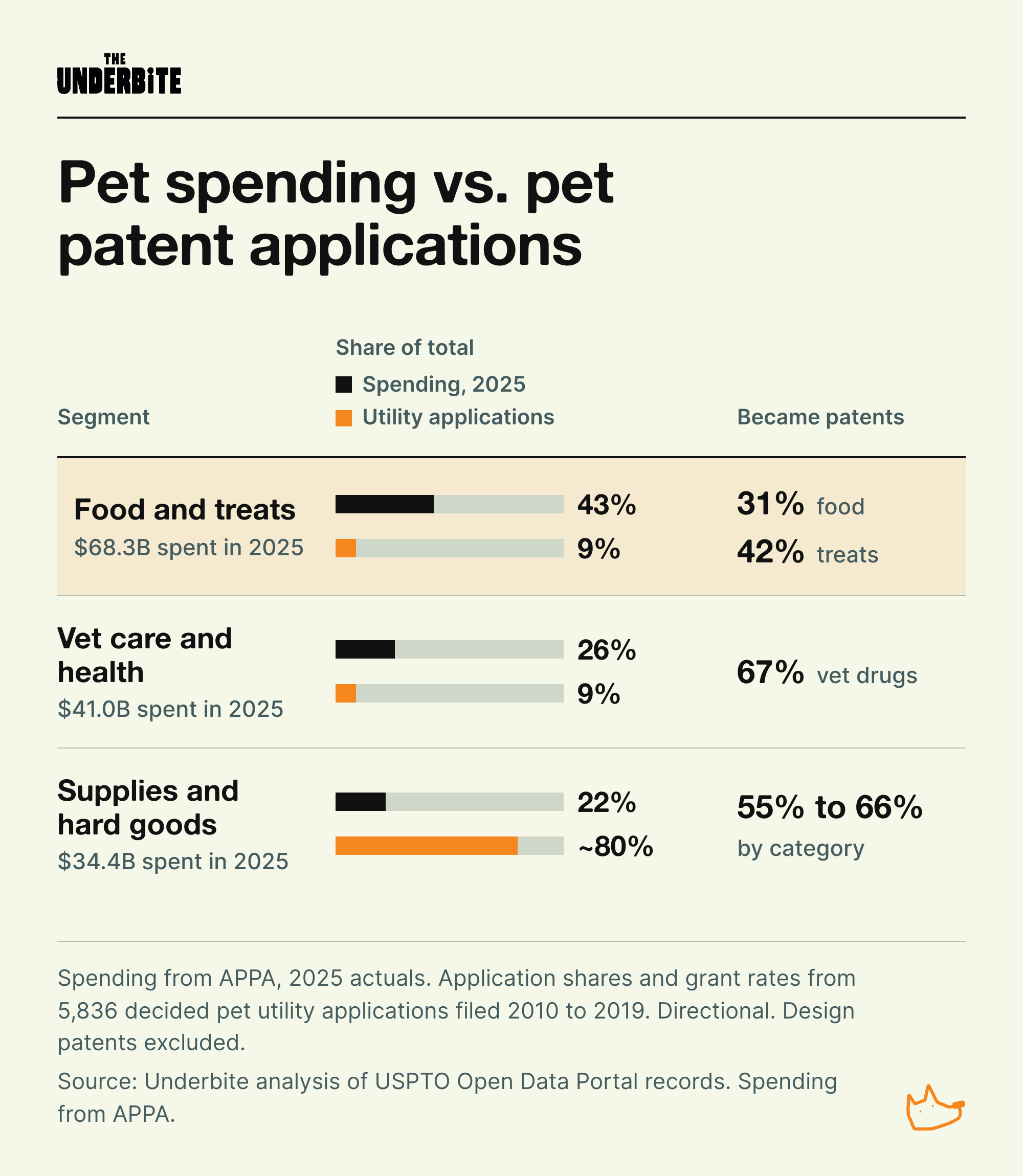
The gap is widening. Food and treats made up 9.8% of pet utility filings from 2010 to 2014 and 8.3% from 2020 to 2024. The count has held at about 50 to 60 filings a year for 15 years. Over just the last two years, food and treat spending grew from $64.4B in 2023 to $68.3B.
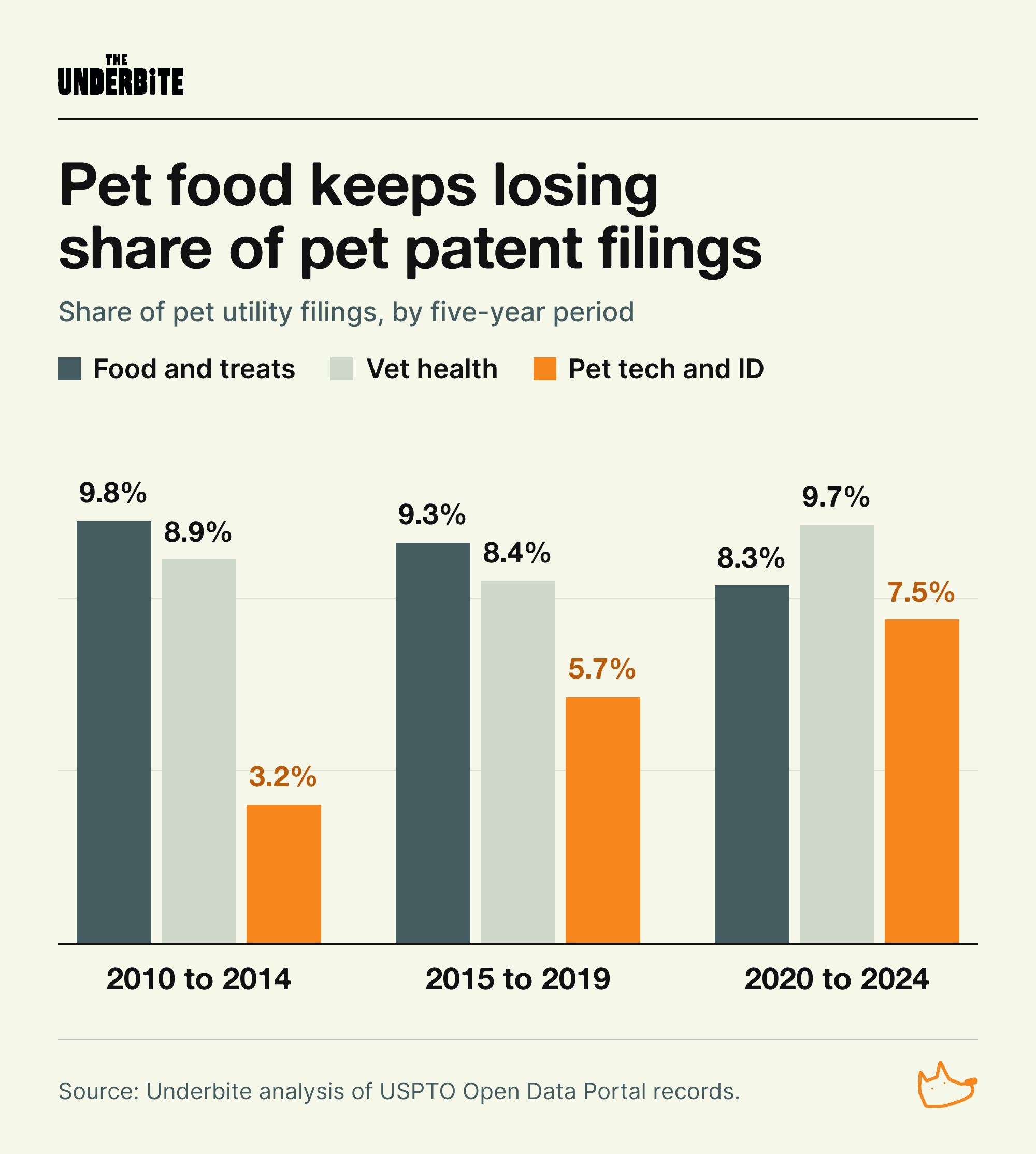
Pet tech and ID tracking went the other way. Their share of filings more than doubled, from 3.2% to 7.5%, and the five-year count grew from 83 to 241.
Pet food also has the lowest grant rate of any pet category. 31% of pet food utility applications filed from 2010 to 2019 became patents, against 56% across all pet categories.
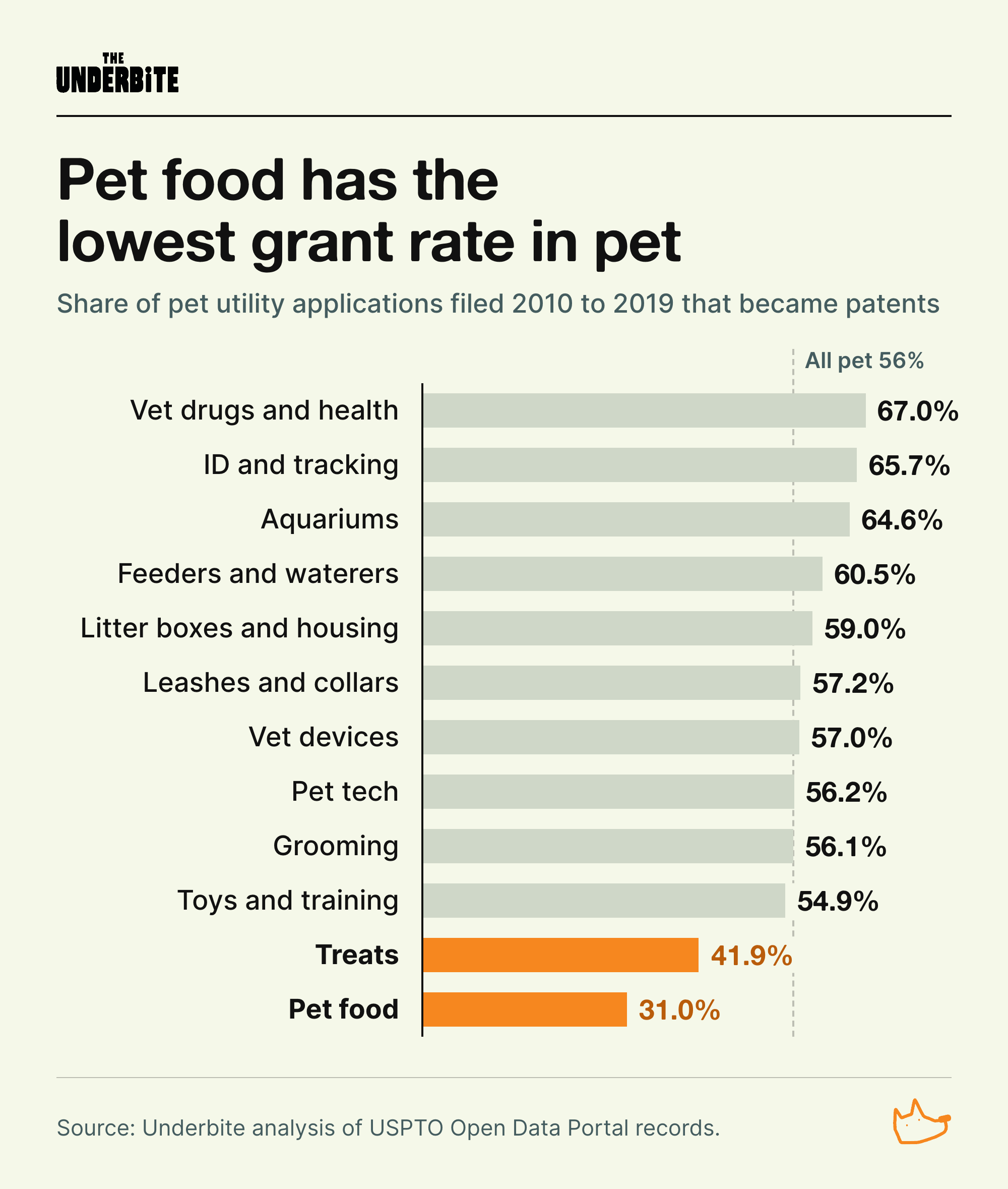
Data behind the chart: share of pet utility applications filed 2010 to 2019 that became patents
- Vet drugs and health: 67%
- All pet categories: 56%
- Pet food: 31%
The food brands that are actually winning built on recipes and supply chains instead. Freshpet passed $1.1B in net sales in 2025, up 13%, and its annual report says it relies on “unpatented proprietary expertise, recipes and formulations” and trade secrets. Shoppers are following the fresh brands. NielsenIQ data shows refrigerated and frozen dog food grew 13.4%, or $208M, while total dog food slipped 0.2%.
The food patents that do get filed have drifted from function to format. Looking across the abstracts of pet food and treat applications since 2005, 44% of those filed from 2005 to 2009 described a health benefit or a condition. For 2020 to 2025 filings, it was 31%. Mentions of fresh, raw, frozen or freeze-dried food went from 4% to 7%.
The newest food filings are about inputs. One patent covers protein from black soldier fly larvae. Evonik has applications to replace fish oil with algae oil.
The strongest pet patents start inside the animal
Health is where pet patents hold up best. Vet drug and health applications became patents 67% of the time, the highest rate in pet. In 2026 so far, the USPTO has granted 12 patents on antibodies for dogs and cats. Most of them block the signals that make a dog scratch. At least three go after dog cancers, including lymphoma. Merck Animal Health holds six. Zoetis holds three.
The big food companies are filing on health and data too. Mars’s 2026 grants read like a software company’s. One identifies a pet from a photo of its nose by checking how the nostrils line up. Another analyzes a photo of a pet’s stool. A third takes thermal readings of a pet while it eats two different foods and compares them. Its applications go further. One detects a dog’s emotions from video. Another finds a pet’s relatives from its DNA.
For most of pet care’s history, owners have worked from the outside in. Switch the food or add a supplement, then watch for a firmer stool, calmer skin or an easier climb up the stairs. The newest filings run in reverse. They start with what’s happening inside the animal and pick the food from there.
Mars has an application that recommends a food based on the microbiome in a pet’s stool sample, and it already holds a patent on a genetic test for liver copper buildup in dogs. Nestle has applications that estimate a dog’s or cat’s “probability of healthy lifespan” from blood biomarkers. PrettyLitter holds patents on litter that changes color to flag a health problem.
Two more applications chase weight and blood sugar with GLP-1, the drug class behind Ozempic. One targets obesity in pets. Another, from UPenn, targets diabetic cats. About 1 in 8 American adults already take a GLP-1, according to a recent KFF poll, and now the cat gets a turn.
Some filings go deeper still. One active US patent uses CRISPR, a gene-editing tool, to remove the gene behind Fel d 1, the main cat allergen. And human drugmakers are showing up. Jazz Pharmaceuticals, which makes the CBD drug Epidiolex, filed an application for a cannabis compound to treat epilepsy in dogs.
Most pet patents die before full term
Only 36% of granted pet utility patents make it to full term. Across all US patents, the figure is about 40%, according to Patently-O.
A US utility patent stays alive only as long as the owner keeps paying, with fees due at 3.5, 7.5 and 11.5 years. A small entity pays $860, $1,616 and $3,312. A large company pays $2,150, $4,040 and $8,280.
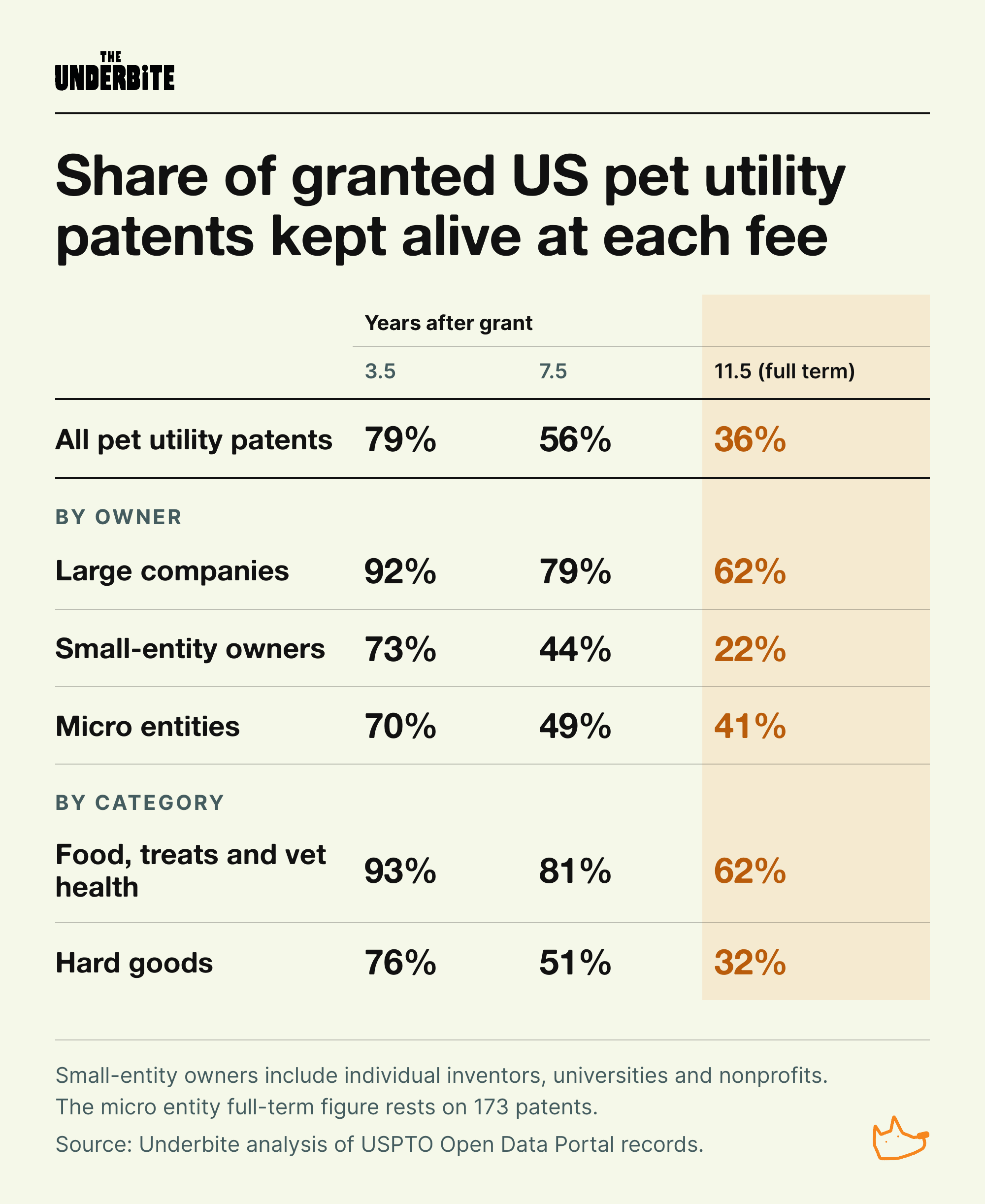
Includes only patents whose payment window has closed, so the full-term column reflects patents granted roughly 2014 and earlier.
Small-entity owners keep 22% of their pet patents to the end, about a third of the large-company rate. Hard goods patents reach full term at about half the rate of food, treats and vet health.
The more interesting group is the owners sitting right in front of a deadline. By the 7.5-year mark, 56% of small-entity pet patents have gone unpaid. An owner facing a $1,616 renewal bill for a product they stopped selling is the most likely seller or licensor in pet IP.
90+ big-brand pet patents expire by 2028
Large companies keep 62% of their pet patents to full term. What they hold is the science that matters, and a lot of it hits its end date in the next two years.
We count more than 90 active utility patents from big pet and animal health companies with estimated expiry dates in 2027 and 2028. About a quarter cover training collars and pet containment systems. The rest spread across vaccines, gut health, aging, weight control, skin and thyroid care, from Hill’s, Mars, Boehringer Ingelheim, PetSafe and others.
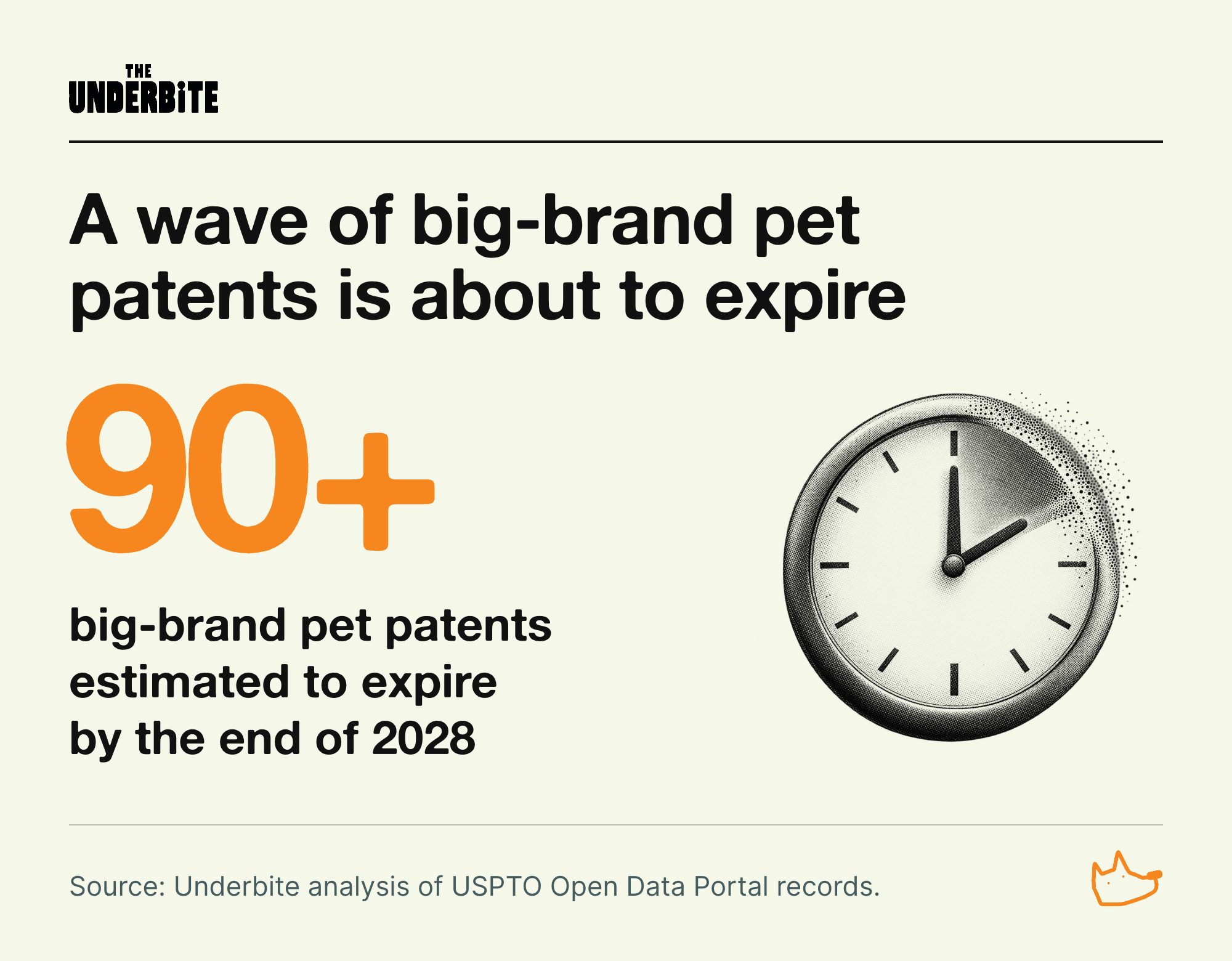
One example is a Mars patent on a canine probiotic Bifidobacterium strain, first filed by Iams. The strain was isolated from the intestinal tissue of dogs, and it’s the kind of gut-health science premium and prescription diets sell on. We estimate the patent expires July 14th, 2027.
Patent expiry rarely opens the market overnight. The FDA approved the first generic version of Boehringer's heart drug pimobendan on April 25th, 2024, and it reached the market after June 9th, 2026. Boehringer spent those two years launching a liquid version and adding new uses to its label.
Our expiry dates are estimates built from filing dates and term adjustments. About a fifth of the patents on our list carry a terminal disclaimer, which can pull the end date earlier, and newer patents may still cover the same products.
The challengers who plan for these dates now will be the ones with product on the shelf when they arrive.
In 2025, 865 of 1,111 new US pet designs named an inventor in China. Ten years ago it was 12.
The next decade of pet products is already on file at the USPTO.
Keep reading
- What Pet Brands Get Wrong About China Sourcing
- Tariffs Are a Cost Structure Now, Not a Crisis
- Pet Wearables: The Business Model Problem
Cite this: The Underbite, "China Now Designs Most of America's Pet Hardware," October 7, 2026. https://www.theunderbite.co/technology/china-pet-hardware-patents-2026
Affiliated Products
Lorem ipsum dolor sit amet, consectetur adipiscing elit. Suspendisse varius enim in eros elementum tristique. Duis cursus, mi quis viverra ornare, eros dolor interdum nulla, ut commodo diam libero vitae erat.