BPC-157 for Dogs: Peptides, Bad Vials and the FDA Gap
Dog owners are injecting BPC-157 and TB-500 with dosing worked out on Reddit. About 30% of tested vials come back wrong, the FDA vote covers people, not pets, and no canine trial exists yet.
Key findings
- On July 23, 2026, an FDA advisory committee voted to recommend six peptides, including BPC-157 and TB-500, for the 503A compounding list, over the unanimous objection of FDA staff scientists.
- 503A covers custom prescriptions for people. It is not an animal drug approval and does not make these compounds lawful for dogs.
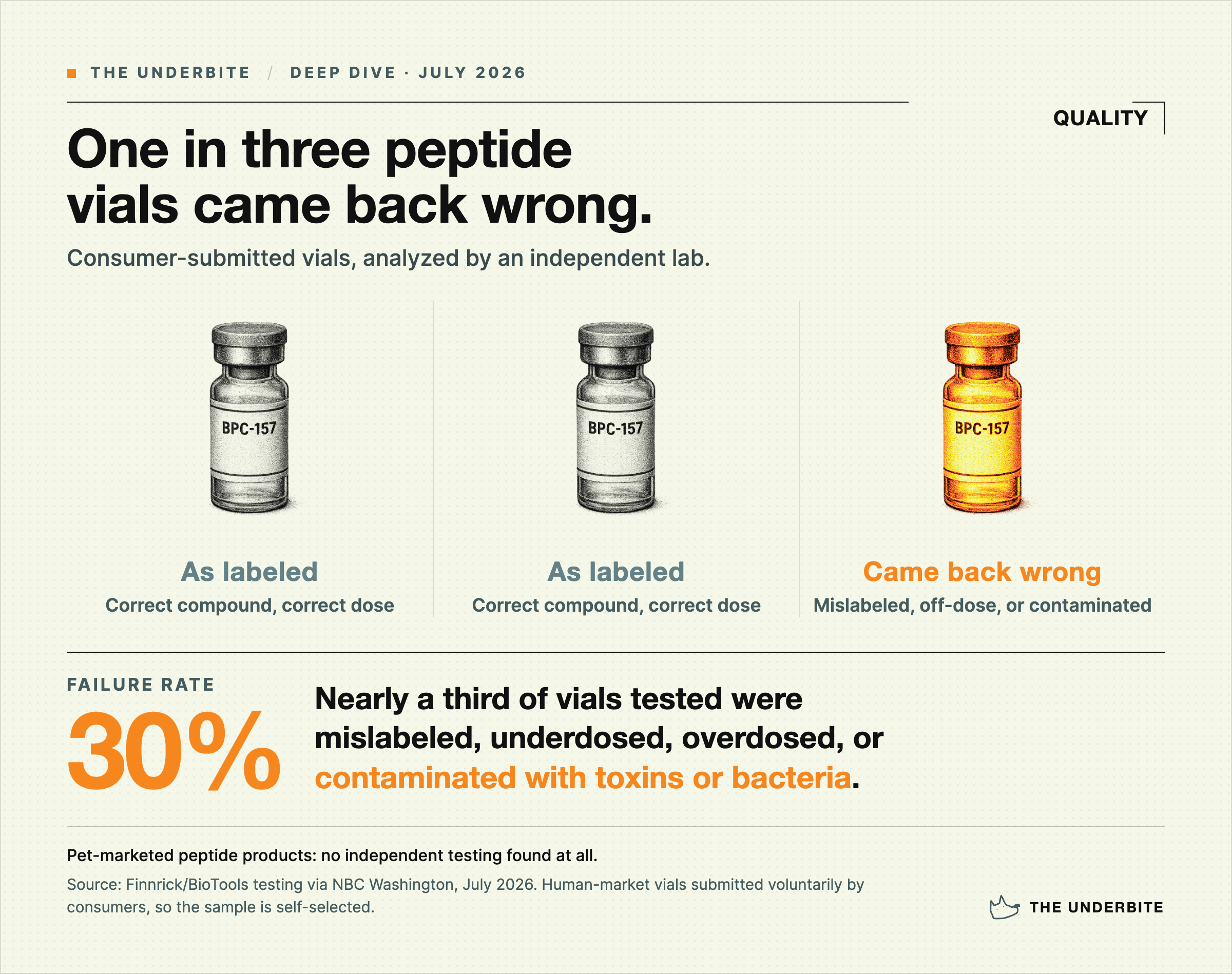
- Almost 30% of consumer-submitted peptide vials tested by an independent lab came back mislabeled, off-dose or contaminated (NBC Washington).
- K9-REPAIR, a BPC-157 and TB-500 product for dogs, sells for $80 a pack as oral drops or an injectable, with no prescription step on its order page (The Underbite check of pawgen.com, November 14, 2026).
- US trademark filings that name peptides rose from 53 in 2019 to 481 in 2026 through November 11, about 9x. Filings for scientific, research or laboratory use, a group that includes legitimate reagent makers and the label grey-market vendors sell under, rose from 27 to 276 (The Underbite count of USPTO records).
- There is no randomized controlled trial of BPC-157 in dogs.
- Gallant has raised $68M over eight years on the FDA route for pet stem cell therapy. A dog peptide protocol launched the same day as the vote, with no FDA review.
Update, November 14, 2026: On October 28, HHS announced a draft, interim enforcement-discretion policy, published October 30. It says HHS would not act against licensed pharmacies that compound the six peptides for patients with a prescription, under 10 conditions, while FDA writes a final rule. Comments closed November 13 (Arnold & Porter). The policy is written for human prescriptions. It does not approve any peptide and does not add any to the 503A list. First sent in the newsletter on July 29, 2026.
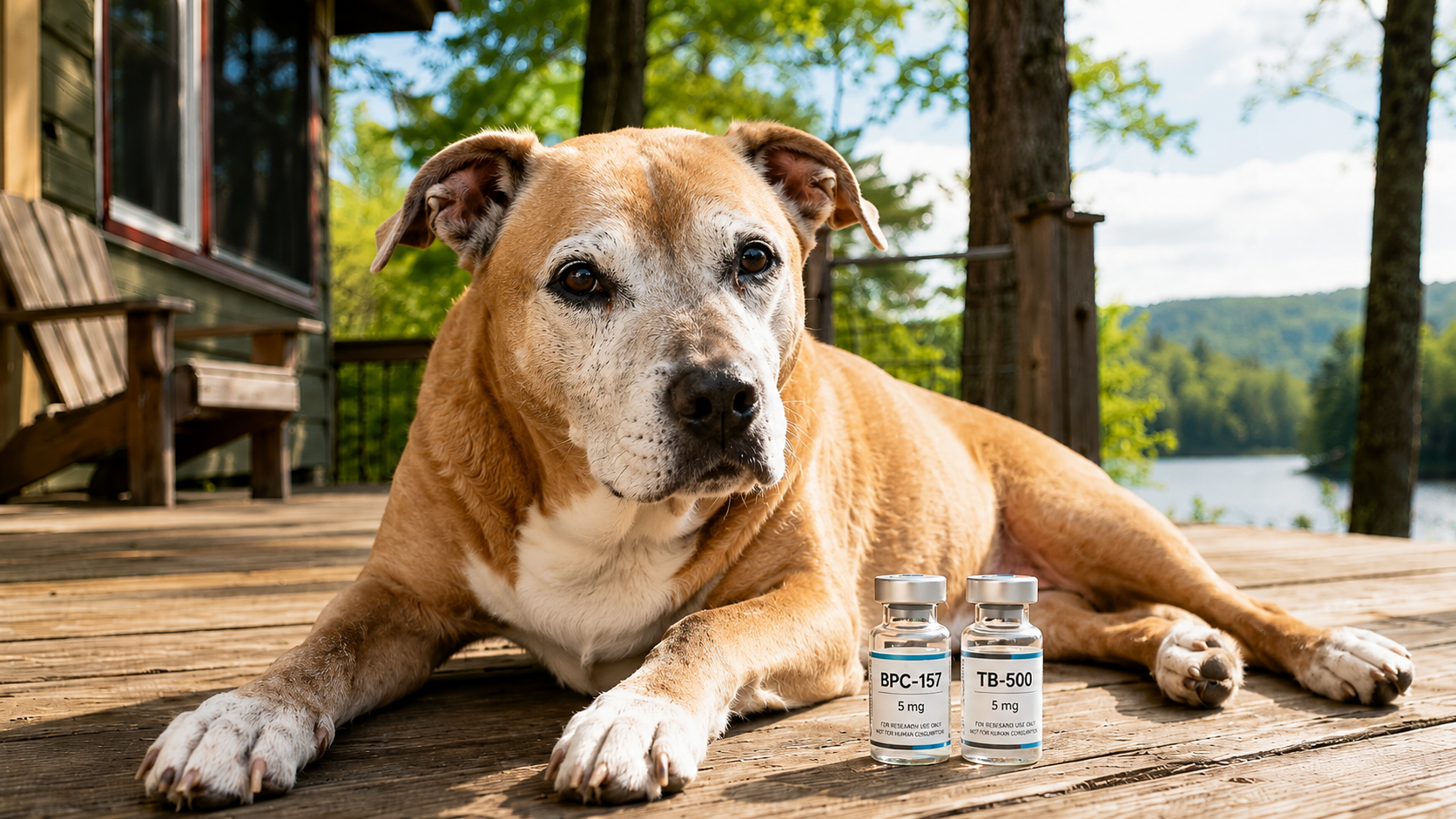
On July 23, 2026, Michael Morelli posted a long thread about his 14-year-old dog. Morelli is a fitness influencer with a large following who has gone all in on peptides, for himself and now for his animals. Six months earlier the dog was limping, stiff, unable to get on the couch, and the family was counting down. Morelli put him on BPC-157 and TB-500 at 1mg to 2mg a day, five days on and two off, injected the way you would inject a person. Then a bioregulator stack. Then testosterone, working up to 60mg a week for a 70-pound dog, split into two shots because the levels dropped by day five.
The dog is running again. Morelli believes he bought another three years.
The same day, he launched a dog peptide product through his brand, Pawgen.
Also that Thursday, an FDA advisory committee voted to recommend six peptides for the list of bulk ingredients that compounding pharmacies may legally use, over the unanimous objection of the agency's own scientists. A testimonial, a product, and a regulatory signal inside 24 hours, with no clinical trial anywhere in the sequence.
What the panel actually cleared
Peptides are short chains of amino acids. Some are among the most rigorously tested drugs in medicine, since insulin and semaglutide are both peptides that went through full clinical trials and FDA approval. The six the committee recommended did not.
BPC-157 is a synthetic 15-amino-acid fragment of a protein found in human gastric juice, sold for tissue and joint repair. TB-500 is marketed as thymosin beta-4, a wound-healing protein. KPV is an anti-inflammatory tripeptide, and the other three are pitched at metabolism, sleep and cognition. Online, BPC-157 paired with TB-500 is called the Wolverine stack. Neither that name nor the dosing came from a laboratory.
Margins were narrow, with BPC-157, KPV and TB-500 each clearing 8-6 with one abstention. The panel rejected a seventh, emideltide, over evidence FDA considered especially weak.
FDA staff scientists had unanimously opposed every peptide on the agenda, according to ABC News. Six of the eight members recently appointed under HHS Secretary Robert F. Kennedy Jr. run clinics that offer peptides.
The vote bound nothing on its own. FDA still had to publish proposed rules and take comment, which can run a year. On October 28, HHS announced a draft enforcement-discretion policy. It says HHS would not act against pharmacies that compound the six for human prescriptions, under set conditions, while that rule is written.
Nobody knows what is in the vial
FDA's own review found BPC-157 not well-characterized, citing naming conventions that do not follow chemical standards and missing data on identity and purity. Reviewing the lab certificates vendors submitted, the agency found "no testing results for the quality control attributes on specified impurities, aggregates, bioburden load and/or bacterial endotoxin levels." For a product people inject, FDA considers sterility and contamination testing basic.
The TB-500 paperwork was worse. There are two versions of the compound, a base form and a salt form, and the nomination FDA received could not keep them straight. It named one version, attached a lab certificate for the other, and listed a second chemical ID number and a molecular formula that matched neither. The nomination could not say which chemical it was describing.
Russell Wesdyk, an associate director for regulatory affairs at FDA's drug evaluation center, put it plainly at the hearing. "When you write a script for TB-500, what form do you think your patients are getting? Does anyone know? I certainly don't."
Independent testing supports him. Rina Dukor, whose lab analyzes vials submitted by consumers, told NBC Washington that almost 30% of samples came back mislabeled, underdosed, overdosed, or contaminated with toxins or bacteria, and that they find live or dead bacteria in a lot of the vials. A peer-reviewed analysis by Belgium's national public health institute of the ten most-seized black-market peptides found some peptides only 5% to 75% pure, with arsenic and lead present, some samples at more than eight times the toxicity limit for injectable drugs.
Data behind the chart: peptide vial testing
- About 30% of consumer-submitted vials came back mislabeled, underdosed, overdosed or contaminated (Finnrick and BioTools testing via NBC Washington, July 2026)
- Sample: human-market vials submitted voluntarily, so it is self-selected
- Independent testing of pet-marketed peptide products: none found
There is no American supply chain underneath any of this. Dr. Abud Bakri, an internal medicine physician who discussed peptides at length on Andrew Huberman's show, was blunt. "There are no such thing as American-made peptides," he said. The raw material comes from China and gets finished here. He put US grey-market spending at $5B to $10B in 2025.
Products labeled for pets now exist. But the dosing conversations happening online are mostly about human vials, bought from the same research-chemical sites and split down by body weight. The failure rate above is not a warning about some other market. It is the supply.
The protocol is being written in comment threads
In a thread on r/seniordogs, owners trade dosing for a 12-pound Pomeranian mix with a heart murmur, a 100-pound cane corso, and an 8-pound Yorkie. One asks how to dose a four-pound dog. Another, unsure how to convert units, is told to ask Grok. A third paid a veterinarian $625 for BPC-157 and now wants to mix it at home to save money.
The most contested question is what to mix it with. Bacteriostatic water contains benzyl alcohol, which suppresses bacterial growth in a vial punctured repeatedly. Sterile water has no preservative, so a mixed vial spoils faster. Owners cannot agree which risk is worse for a dog. "BAC is toxic for pets but sterile water has a pretty big contamination risk," one writes. Another: "We use bac water. I'm afraid of contamination using sterile water. But now I'm worried." A third walks through dosing by body weight, then adds the line that matters most. "You need to make sure you get the real things. There are labs like Finnrick and Janoshik that will test your peptides."
Finnrick is the testing service NBC described. The community knows the supply is unreliable and has organized around testing it privately.
The clearest expression of the problem came from an owner who had not started yet. "This is so confusing, where do you get this stuff from? What's the cost? How often administered? I see some people mention injection and oral alternative. I'm a bit scared to inject my dog. I'm not trained to do that."
These forums are not uncritical, and the sharpest cautions in them come from members rather than veterinarians. One frequent commenter notes that a dog's shorter life compresses the window in which a problem could surface, and advises keeping any cycle short.
Legality is close to the wrong question
Section 503A is the part of federal drug law that lets a licensed pharmacist mix a custom prescription for an individual patient. It applies to people. It is not an animal drug approval and does not make any of these compounds lawful for a dog.
That matters less than it sounds like it should, because pet supplements already sit in a gap you could drive a semi through. DSHEA, the 1994 law that exempted human supplements from proving they work, was never applied to animals, so there is no legal category for a pet supplement at all. AAFCO writes ingredient definitions and approves nothing. The NASC Quality Seal requires audits, adverse event reporting and testing to label claim, all real, and none of it testing whether a product works. FDA withdrew its own guidance on companion animal supplements in February 2020 and never replaced it. USDA moved the same direction in 2025, proposing to rescind the organic pet food standards it had finalized months earlier.
Products ship in the meantime. On November 14, 2026, we checked Pawgen's order page for K9-REPAIR. It sells a BPC-157 and TB-500 product for dogs at $80 a pack, and the order flow asks for no prescription. In our July check, FDA had issued no warning letters naming BPC-157, TB-500 or KPV marketed for animals. In September FDA warned four peptide sellers. On November 14, 2026, FDA's list of animal drug warning letters showed three for 2026, and none named a peptide. So the practical question is not whether a pet peptide is lawful. It is whether a regulator ever arrives.
Veterinarians are triangulating in the meantime. One owner described asking his vet about putting his 8-year-old German shepherd on BPC-157 and TB-500. "He looked into it, said there were reports but nothing in stone. Ended the visit with, I'm not going to tell you to, but I'm also not going to tell you don't."
What the vote changes is the sales pitch. Bakri read the regulatory tea leaves directly. "RFK himself has kind of said, oh, these are supplements. They're not medications. So FDA, we're not gonna regulate them as meds, because they're not meds."
That framing has a precedent. DSHEA passed after a letter-writing campaign largely organized by the vitamin industry, and the US supplement industry it created is now worth roughly $70B. Peter Lurie, president of the Center for Science in the Public Interest and a former FDA associate commissioner, said in a New York Times opinion piece on what the peptide vote implies. "This means that if you could generate enough demand, even illegally, FDA would have to turn a blind eye."
GLP-1s taught Americans to inject something
Nearly one in five US adults (18%) said they had taken a GLP-1 drug in a KFF poll in late 2025. That number is the mechanism.
Ozempic got there first and became a household name, then a punchline, then shorthand. It spread not only because it worked but because the results were visible to other people within weeks and the user could point at the shot that caused them. Millions of Americans learned to handle a syringe and expect a compound to deliver.
Peptides inherit that muscle memory, and if the humanization of pets has taught this industry anything, the writing is on the wall. Several categories that took hold in human wellness have already arrived in the pet aisle. The jump is far shorter than it was for stem cells, which needed a laboratory, a veterinarian and a cold chain. A peptide needs a vial and a willing owner.
The demand signal is visible. Huberman posted in July 2026 that the pet peptide industry is taking off, noting the animal data is mostly mice and that he knows at least three dog owners giving BPC to injured or aging dogs. A poll run by the account 9th Life, asking whether followers would give an injured pet BPC-157 or TB-500, came back 87.9% yes across 414 votes. Bakri, who called himself pro peptide for pets, expects the clearest signals to come from exactly there. "A lot of the positive signals are going to come out of people giving them to their pets."
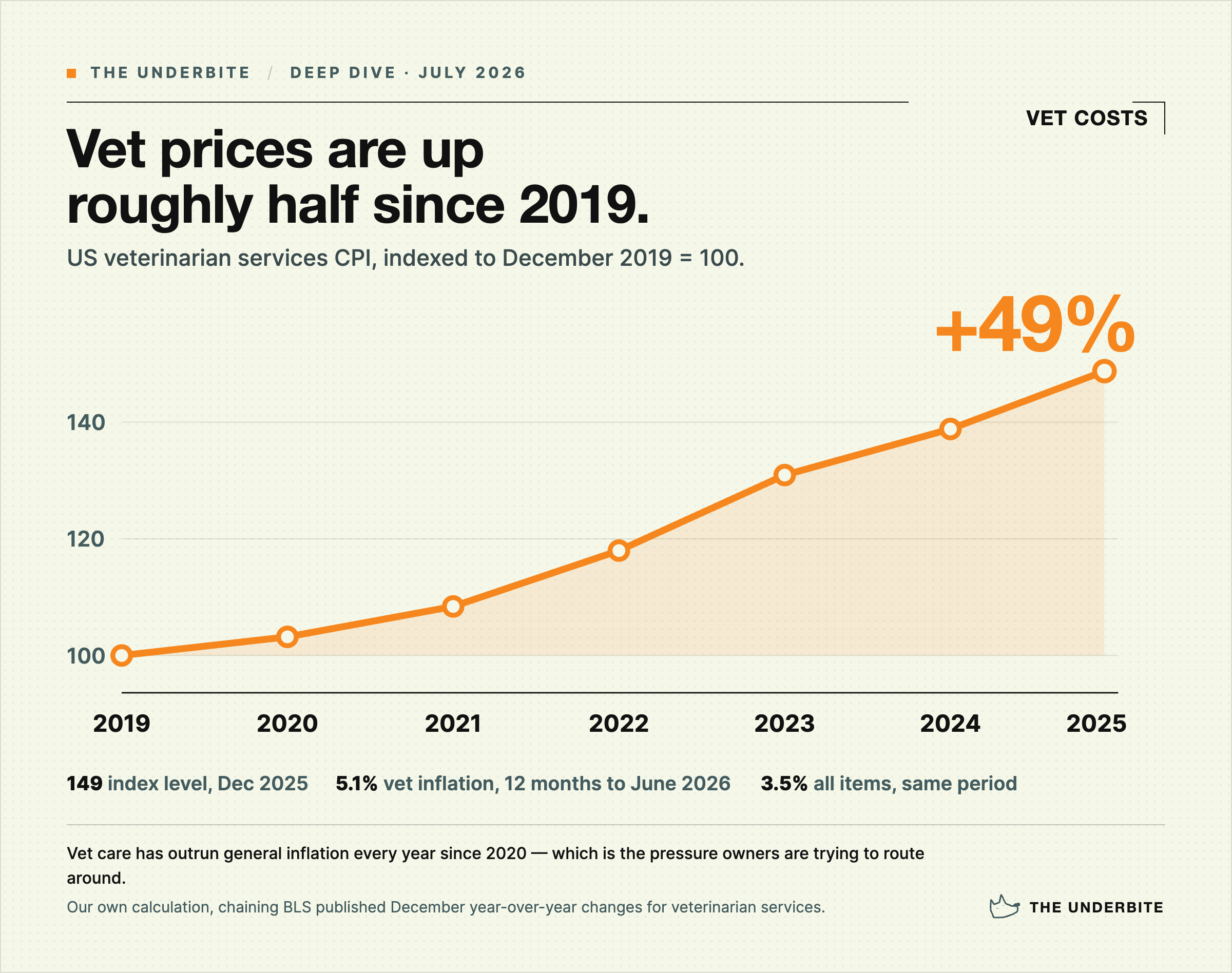
The economics push the same way. Veterinary service prices are up 54% since December 2019 and 4.6% in the 12 months to September 2026 against 3.7% for all items, Gallup found 52% of owners skipped or declined care with cost leading, and insurance covers only 4.27% of US pets. Nationwide caps new enrollment in its major medical plans at nine years and younger. Owners already covered do not get dropped so much as priced out. One policyholder of 13 years described a premium going from roughly $380 a month to $1,300 for two 13-year-old cats and a 12-year-old dog, about $433 per animal.
Data behind the chart: US veterinarian services CPI, December 2019 = 100 (chart runs to December 2025)
- December 2025: 149, up 49%
- October 2026, latest: 154, up 54%
- Vet services inflation, 12 months to September 2026: 4.6%
- All items, same period: 3.7%
- Method: our own calculation from the BLS veterinarian services index (CUUR0000SS62054), not seasonally adjusted
An owner staring at that renewal, or at a $2,000 surgical estimate, is the customer Morelli is now selling to. His brand, Pawgen, sells peptides like BPC-157, as Business Insider reported in September 2026. Its lead product, K9-REPAIR, comes as oral drops or an injectable, with 250mcg of BPC-157 and 100mcg of TB-500 per dropper. It runs $80 for a single pack and $256 for four. Pawgen includes free bacteriostatic water for reconstitution, the same diluent owners on Reddit cannot agree is safe for a dog.
How we know: The Underbite check of pawgen.com/products on November 14, 2026. Prices are list prices before subscription discounts.
The aisle it would take share from never had to prove anything
Hip and joint is the largest slice of the pet supplement category, at 21.56% of global revenue. Its two most common ingredients are also the ones the recent evidence has treated worst.
A 2022 systematic review covering 72 trials found what its authors called a very marked non-effect for chondroitin-glucosamine and recommended against further use for pain in dogs and cats. A 2023 trial put it to a harder test, walking dogs across a plate that measures how much weight each limb carries, which takes the owner's judgment out of the result. Dogs given glucosamine and chondroitin did not improve more than dogs given a placebo. Dogs given an anti-inflammatory drug or one of two marine oil products did.
Nutramax, which makes Cosequin, the joint supplement sold in nearly every pet aisle in America, agreed to an $11.5M settlement over its marketing in 2026. A settlement is not a finding that any law was broken. Nutramax agreed to stop printing several phrases, including the instruction to use Cosequin to help a pet climb stairs, rise and jump.
Even the category's size is contested. Packaged Facts puts US sales at $2.9B in 2025 with growth now below 3%, while L.E.K. Consulting reads the same market closer to $5B and still growing double digits, depending on whether topicals and functional treats count.
Peptides are not new here, and the word covers several businesses. Oral collagen peptides sit in joint supplements today with real trial data behind them, including a 2024 randomized placebo-controlled study measuring gait in arthritic dogs, published in PLOS ONE and funded by Gelita, the supplier whose collagen it tested. What changed is not that peptides arrived. It is which ones, sold by whom, on what evidence.
What the slow path costs
While the grey market was building, Gallant spent years working through discovery, clinical trials, QC, and the FDA approval process.
Aaron Hirschhorn had already built and sold DogVacay to Rover when an injection of his own stem cells, drawn from his bone marrow, fixed a jiu-jitsu back injury that nothing else had. He looked at Rocky, his arthritic dog, and asked why the same option did not exist for pets.
His original idea was a banking service, storing a young animal's own stem cells for later. He recruited Linda Black, a veterinarian with a PhD in cell and molecular biology, to run it. She told him the banking business would not make regenerative medicine accessible to most pets, and that the thing worth building was an off-the-shelf therapy any clinic could stock. That version took far longer, generated no revenue for years, and required raising considerably more money. He agreed to fund both.
Black, who became CEO in 2021, kept the company on that route and built its own manufacturing rather than hand production to a contractor. "It's the only way we're going to be considered legitimate," she told us on our podcast.
Stem cells are harvested from a uterus removed during a routine spay, tissue otherwise discarded, and one donor yields more than 30M doses. Gallant went after refractory feline chronic gingivostomatitis first because minor use minor species status opens the conditional approval pathway, which requires a reasonable expectation of effectiveness rather than full proof.
By day 90 in the published field study, 79% of treated cats met the threshold on owner-reported quality of life. On lesion scoring done by the veterinarian rather than the owner, the stricter measure, 45% improved.
Black puts total funding at $68M, on rounds including over $15M in a Series A and $18M in a Series B led by Digitalis Ventures. Eight years in, $68M raised, and the company said in July 2026 that it aimed to have its first commercial product, for refractory feline chronic gingivostomatitis, available that summer. We could not confirm a launch as of November 2026. Its canine osteoarthritis therapy targets conditional approval in 2028. Okava is on a similar road with an implant that releases a GLP-1 drug in cats over six months.
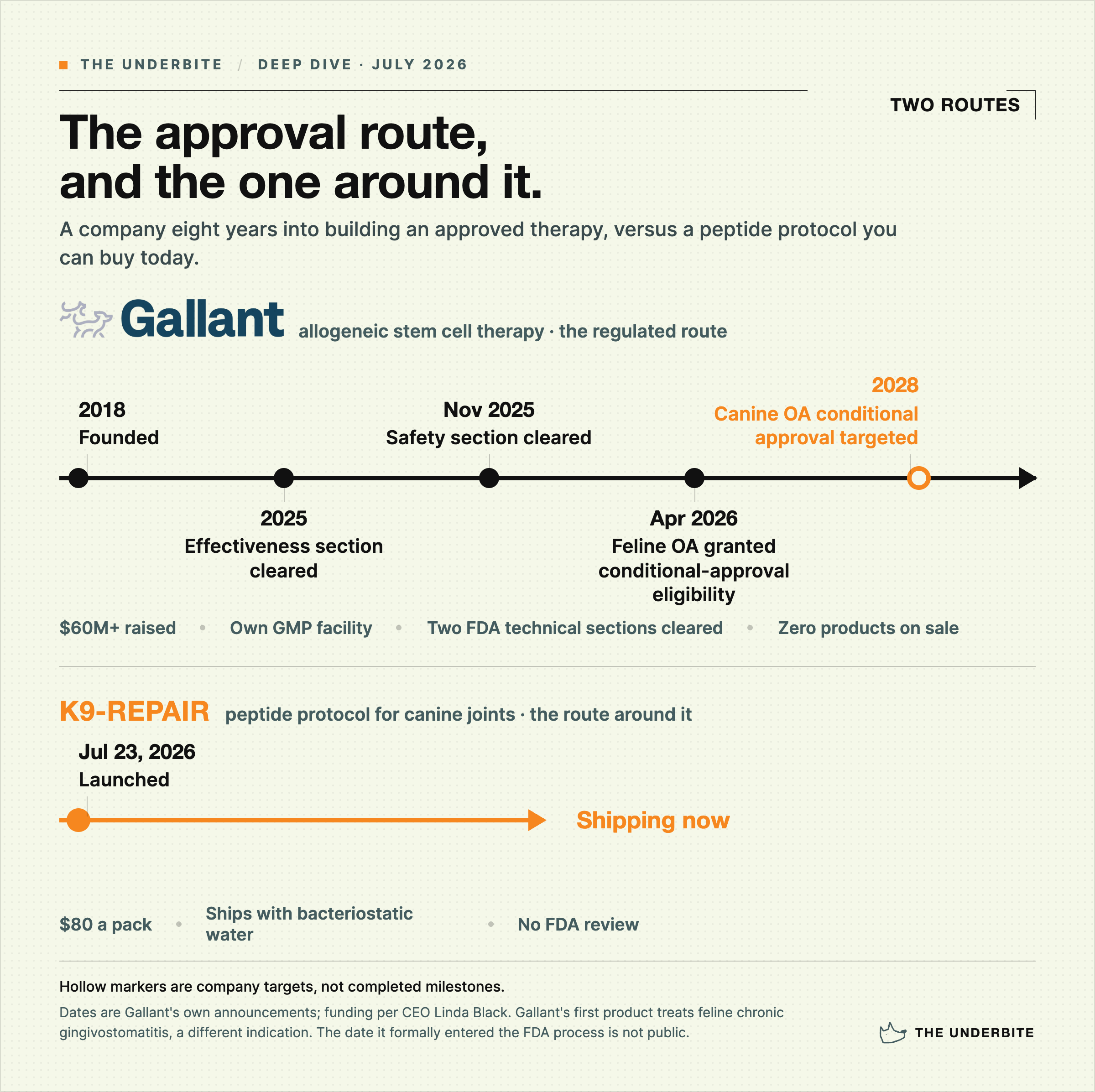
Data behind the chart: two routes to market
- Gallant: founded 2018, $68M raised (per CEO). Feline gingivostomatitis: FDA effectiveness and safety sections cleared in 2025. Feline OA, a separate program: conditional-approval eligibility April 2026. Canine OA: conditional approval targeted for 2028
- K9-REPAIR (Pawgen): launched July 23, 2026, $80 a pack, oral or injectable, free bacteriostatic water, no FDA review (pawgen.com, November 14, 2026)
Gallant and Okava are aiming to sell something a regulator has examined. That is the difference they are paying for.
The case for the other side
The strongest argument for the panel's decision came from a member who voted yes.
"As a physician, I have to make sure that I'm keeping patients as safe as possible," Dr. Haleem Mohammed said. "So, when I look at something like saying no to this and pushing it to the gray market, am I doing greater harm? That's what I lose sleep at night over."
In a market where 30% of tested vials come back wrong and owners are debating diluents in comment threads, that argument deserves a hearing. Adding a compound to the 503A list brings sourcing verification and contamination testing to a supply chain that has neither.
Adriane Fugh-Berman, a pharmacology professor at Georgetown, gave the counter in public testimony. "Would the government endorse manufacturing heroin because it's cleaner than what is sold on the street? Just because a market is large doesn't mean that a product should be legalized. It means that a product should be studied."
Bakri, who is broadly favorable, framed the stakes honestly. "Either BPC is as amazing as we think it is and it's unfortunate that millions of people don't have access to it, or BPC is actually either ineffective or harmful and millions of people are injecting it right now. Both cases are very bad endpoints."
Three things sit under the animal version. The dog safety study people cite, Xu and colleagues in 2020, found BPC-157 well tolerated, but it was given as an injection into muscle. Most pet products we checked are oral, and FDA says oral safety cannot be estimated from that data. The injectable ones are being mixed at home. Second, BPC-157 works partly by growing new blood vessels, useful for healing tissue and unhelpful if an animal already has a tumor that needs a blood supply, and the dogs being dosed are disproportionately old. Bakri notes no cancer signal has appeared in the animal literature, while also noting nearly all of that literature comes from a single Croatian research group. Third, no mandatory adverse event reporting covers compounded or unapproved animal products, so a problem would surface slowly if at all.
Drug manufacturers made the structural objection at the hearing, warning that adding these compounds creates a loophole around the trials normally required for approval.
Where this goes
There is an animal peptides market report. Future Market Insights sizes the US at $239.1M in 2025, but globally its largest peptide type is collagen, its largest species is poultry, and 58.3% of it is powder. The measured market is feed hydrolysates and joint collagen. The one people are injecting into dogs is not in it.
The trademark office shows where the supply side is heading. We counted every US trademark application that names peptides in its goods and services. Filings rose from 53 in 2019 to 167 in 2024, 277 in 2025 and 481 in 2026 through November 11. The fastest-growing group is marks for scientific, research or laboratory use, a group that includes legitimate reagent makers and the research-use-only label that grey-market vendors sell under, up from 27 in 2019 to 276. Marks that name pets directly are still rare, 4 to 12 a year with some false matches, including a PET-TIDES application for pet wellness products filed in April 2026. The brand names are being claimed before the products have evidence behind them.
How we know: The Underbite count of USPTO trademark search results for "peptide" in goods and services, all statuses, by filing date, run November 14, 2026. We read 2,285 of 2,346 records, so the counts are a floor. Research-use marks are those whose goods and services mention scientific, research or laboratory use.
More pet peptide products are likely coming, marketed on credibility borrowed from a decision that does not cover them. That borrowing is not new. Plenty of supplement brands already build a label around one ingredient with published research behind it, then never test the formulation they actually sell. Peptides make the move cheaper, because now the borrowed authority is a federal advisory panel.
The opening is real anyway. There is no randomized controlled trial of BPC-157 in dogs. Not one. Whichever brand runs the first credible canine trial gets to say something no competitor in the joint aisle can say, in an aisle where the two most common ingredients failed a weight-bearing test.
FDA is now writing the rules that follow the July vote. Somewhere inside that window, a peptide brand decides whether to fund a trial or a media buy.
Watch which one goes first.
Keep reading
- The race to own dog aging
- Why vet clinics don't post prices, and who is changing that
- Pet supplement survey: vets lead owner research by six points
Cite this: The Underbite, "BPC-157 for Dogs: Peptides, Bad Vials and the FDA Gap," July 29, 2026. Updated November 14, 2026. https://www.theunderbite.co/health-vet-care/bpc-157-dog-peptides-fda
Affiliated Products
Lorem ipsum dolor sit amet, consectetur adipiscing elit. Suspendisse varius enim in eros elementum tristique. Duis cursus, mi quis viverra ornare, eros dolor interdum nulla, ut commodo diam libero vitae erat.