Dog Longevity Research Is Booming. Pet Brands Are Selling Supplements Instead.
Dog aging papers more than doubled since 2015 and the FDA now approves antibodies and conditional drugs for dogs. Pet brands filed a record 1,040 health trademarks in 2025, almost all for supplements. Four datasets show where the science and the money are heading.

In the same week in October 2026, one startup raised $200M to clone and gene-edit military working dogs and another raised $5M to license human cancer drugs for dogs and cats.
Warhound sells to the military and Familiar is building drugs for pets, yet both bets assume the next big gains in dog health come out of a lab. We wanted to see whether the rest of the market agrees, so we pulled four datasets that each track a different part of the business:
- Research papers on dogs and cats indexed on PubMed since 2015
- Every original FDA approval for a dog drug since 2015, plus the USDA list of licensed dog biologics
- 22,121 US pet patents
- 145,539 US pet trademarks, of which 10,711 cover a pet health product
The research and the regulators moved toward hard, expensive science. The brand filings moved the other way, into supplements.
The research left general practice behind
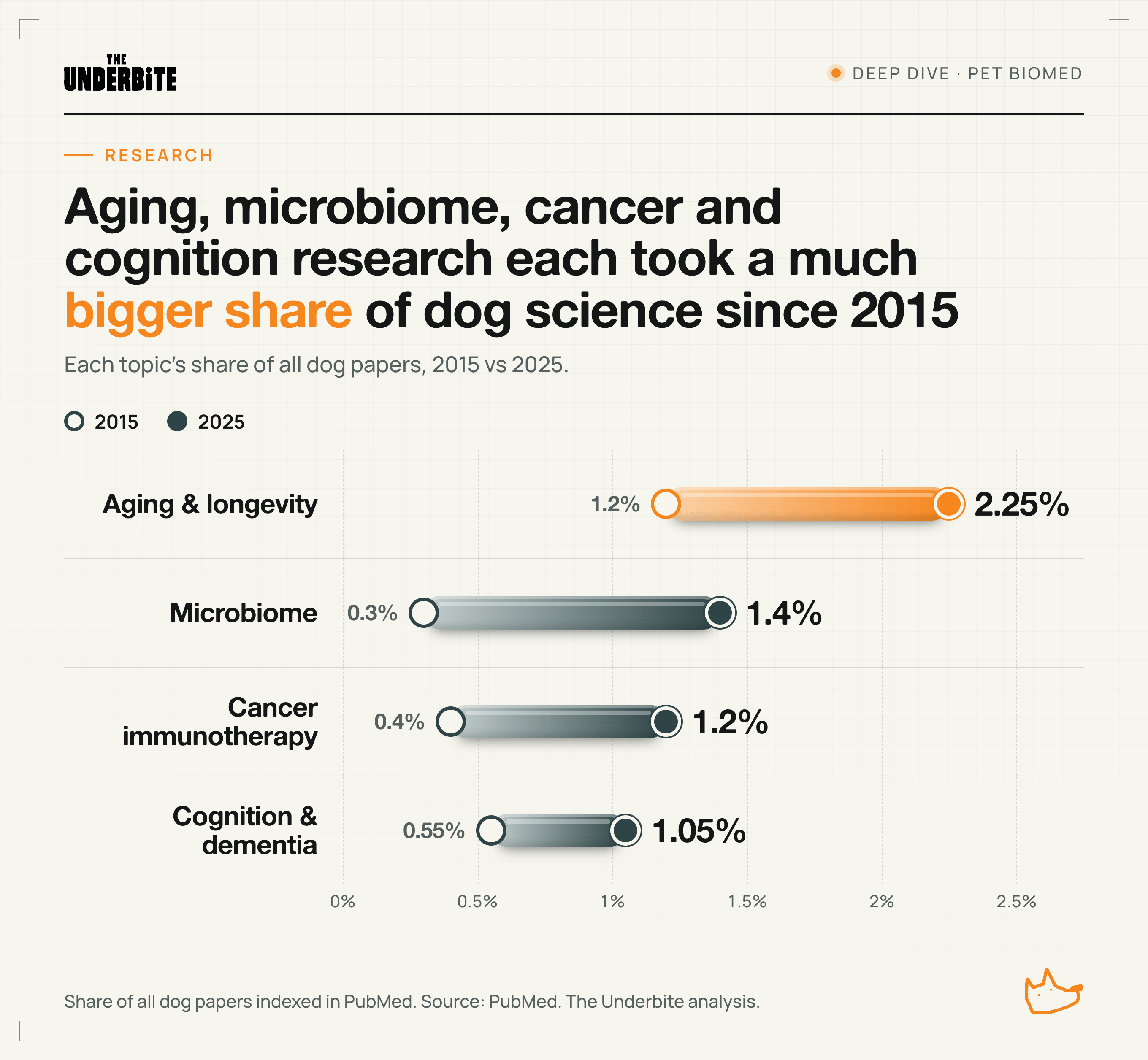
PubMed indexed 6,847 papers about dogs in 2015 and 8,917 in 2025, up 30%. A handful of topics grew far faster and took a bigger slice of all dog research, per our count of PubMed records:
- Dog aging and longevity - 82 papers to 201, from 1.2% of dog papers to 2.25%
- Dog microbiome - 21 to 124, from 0.3% to 1.4%
- Dog cancer immunotherapy - 29 to 107, from 0.4% to 1.2%
- Dog cognition and dementia - 38 to 94, from 0.55% to 1.05%
- Dog Aging Project - 0 papers in 2015, 26 in 2025
Those 4 topics grew 9% to 19% a year, against 2.7% a year for dog research overall.
2026 has already logged 191 aging papers with 2 months left. Papers on epigenetic aging clocks hit 36 this year, against 28 in all of 2025, led by a study in Science on October 8th that showed why big dogs age faster at the level of their DNA. It came from the Dog Aging Project, a long-term study that has enrolled more than 50,000 dogs since 2018.
Cats are on the same curve. Cat aging papers grew 225% over the decade, and 2026 has already passed 2025 with 255 papers.
One area went backward. Dog cell and gene therapy papers fell 7%, which makes a $200M bet on gene-edited dogs look even lonelier.
A 2018 law opened a fast lane for dog drugs
Until 2018, the FDA could only grant conditional approval, which lets a company sell a drug while it finishes proving the drug works, for minor species and rare uses. The user fee law Congress passed that August opened it to drugs for dogs and cats when the condition is serious or the drug meets an unmet need, and when proving it works would take an especially hard study.
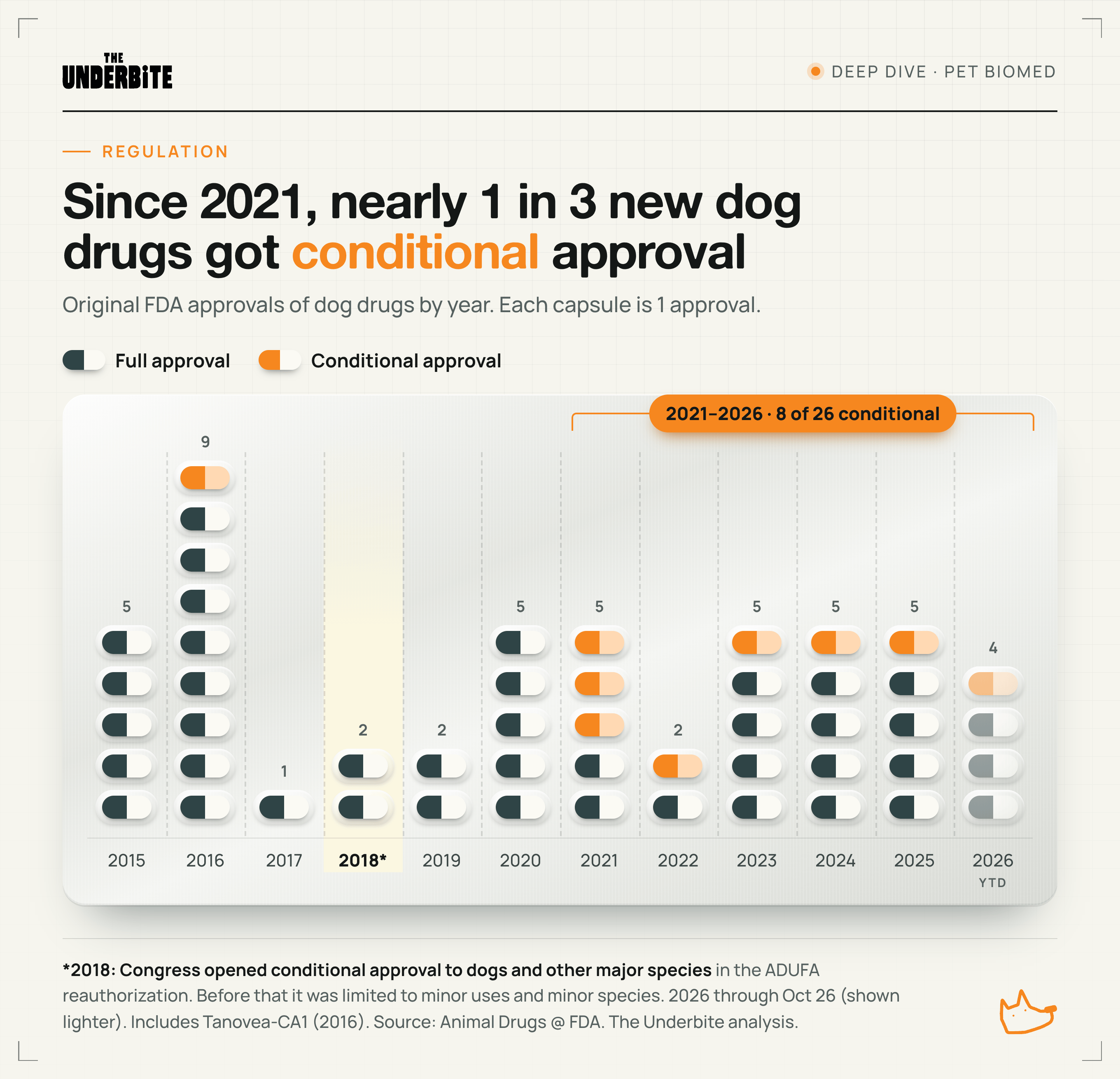
Companies used it right away. From 2015 through 2020, only one dog drug came in conditional (Tanovea, for lymphoma, in 2016). In January 2021, an epilepsy drug called KBroVet-CA1 became the first conditional approval under the expanded rules, and at least one dog drug a year has come in conditional since.
That's 8 of the 26 original FDA dog approvals since 2021, or about 31%, per our analysis of the FDA's animal drug database. They cover epilepsy, heart failure, pancreatitis, lymphoma, chemo side effects, screwworm and a painful skull malformation in small breeds.
The most recent is Liavium-CA1, a pain drug for that skull malformation, conditionally approved in May on the strength of a pilot study. The queue behind it is longer. Gallant's arthritis therapy for cats got the FDA's sign-off in April that it qualifies for the expanded path as an unmet need (arthritis isn't life-threatening), and its dog arthritis program qualified in May, with a conditional approval targeted for 2028.
The total number of approvals barely moved, about 1 to 8 a year.
What changed is what gets approved:
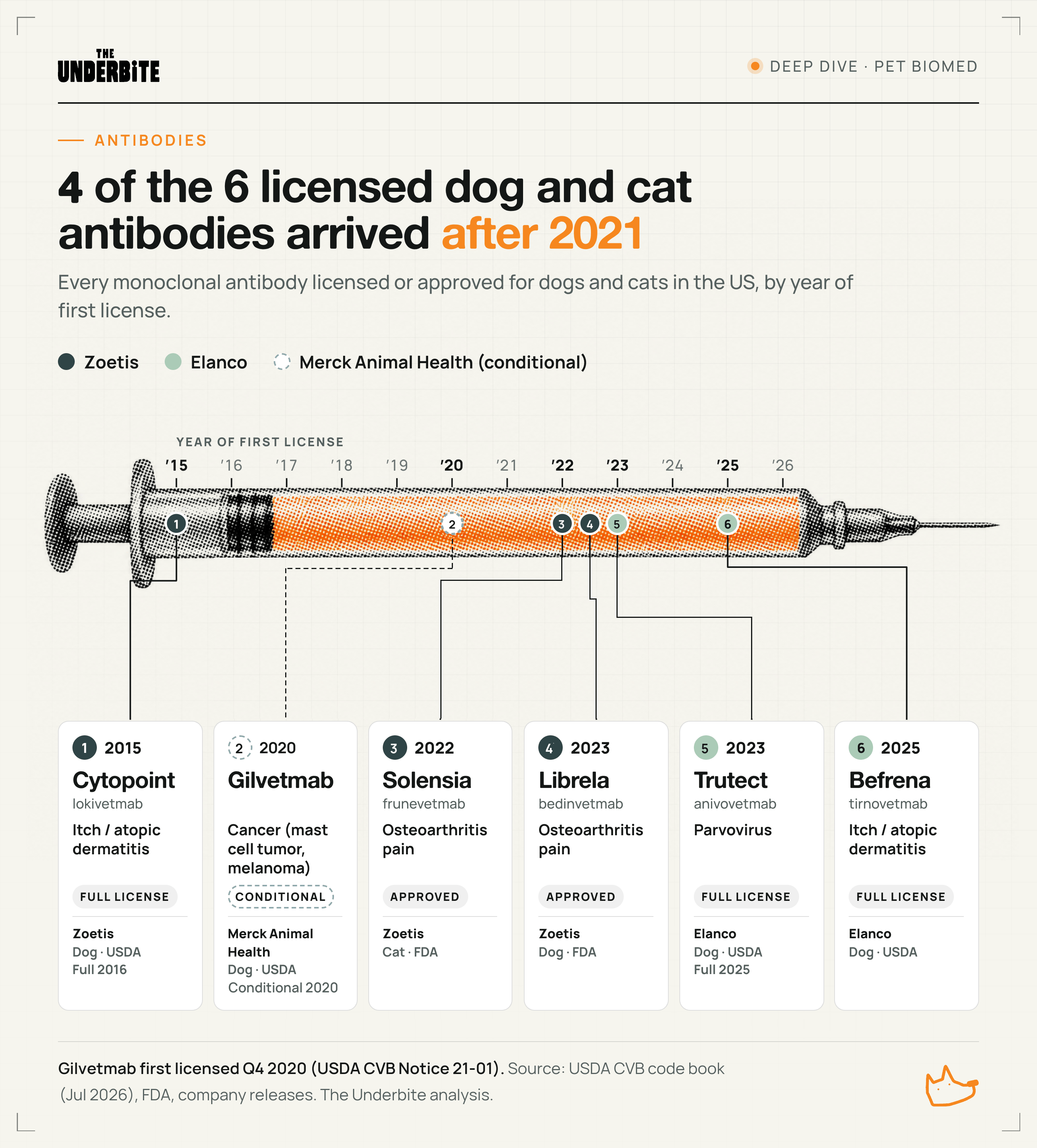
- Antibodies - Dog-targeted antibody drugs went from 1 in 2015 (Cytopoint) to 5 today. 4 are licensed by the USDA and 1, Librela, is FDA approved. 2 arrived in December 2025, when Elanco's Befrena was licensed and its parvo antibody got full approval.
- New drug classes - Elanco's Zenrelia in September 2024 and Merck's Numelvi in February 2026 are both JAK inhibitors (pills that block the itch signal) aimed at Apoquel's business.
- Cancer - Stelfonta (2020), Tanovea (2021) and Laverdia (2021) gave vets dog-specific cancer drugs where they used to borrow human chemo.
The 3-way fight over dog antibodies
Every one of the 5 dog antibodies on the market belongs to Zoetis, Elanco or Merck, per our count of USDA and FDA records:
- Zoetis - Cytopoint and Librela
- Elanco - Befrena and its parvo antibody
- Merck - Gilvetmab, a cancer antibody still on a conditional license
All 3 are big enough to play a long game. Zoetis booked $9.5B in revenue and $2.7B in net income in 2025, $6.6B of it from pets. Elanco did $4.7B, and Merck's animal health arm did $6.35B, $2.46B of it in pets.
The new drugs hit the leader first. Zoetis' dermatology sales fell 16% in the second quarter to $398M, per its quarterly filing, as Elanco's Befrena and Zenrelia and Merck's Numelvi took share. In August it cut its 2026 outlook to an organic revenue decline of 1% to 3%, after US pet sales had already fallen 11% in the first quarter.
Every challenger is another giant. The fight at the edge of pet medicine is between the incumbents, and they keep buying the startups that get close to an antibody:
- Zoetis - Paid about $85M for Nexvet in 2017, whose cat antibody became Solensia
- Elanco - Paid about $440M for Kindred Biosciences in 2021, the source of its parvo antibody
- Dechra - Agreed to pay up to $520M for Invetx in 2024, an antibody startup that had raised $86M and had no approved product
That's about $1.05B for 3 antibody startups since 2017, per our tally of the announced deal values (counting Invetx at its $520M ceiling).
The antibodies themselves are no sure thing. Zoetis' arthritis antibodies, Librela and Solensia, made $568M in 2025, per its annual report.
Librela fell 6% for the year, and its US sales dropped 32% to $36M in the fourth quarter, while Solensia grew 7%. The flagship dog antibody is shrinking 3 years after launch.
They also fund the edge before it's for sale. Mars and Digitalis Ventures run $400M in pet health venture funds ($100M in 2018 and $300M in 2023), and Elanco launched a $25M venture arm of its own.
The giants buy the antibody risk and leave the longevity risk to outsiders
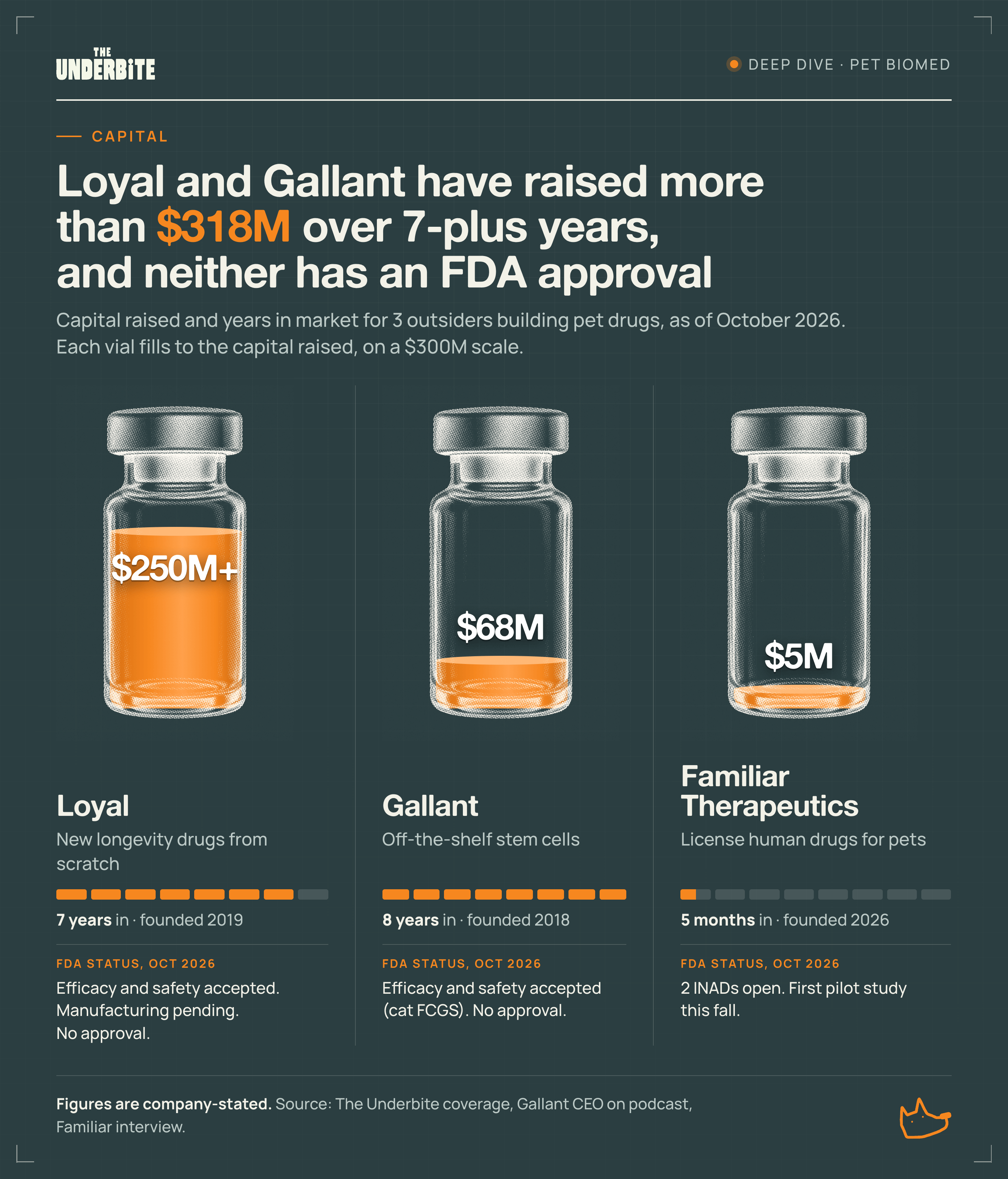
None of them has bought a longevity drug company. The two outsiders furthest along have each spent 7 years proving their science to the FDA, one technical section at a time, and paying for every year of it.
Loyal was founded in 2019 and has raised more than $250M, including a $100M Series C in February. Its lifespan drug LOY-002 has cleared 2 of the 3 major FDA sections, with manufacturing still open, and it is not approved. Zoetis' net income last year alone was about 10x Loyal's lifetime funding.
Gallant started in 2018 as a stem cell banking service for dogs and has since rebuilt itself around off-the-shelf stem cell therapies. It has raised $68M, CEO Linda Black told us on The Underbite podcast after its $18M Series B, with Mars' venture partner Digitalis leading its latest round. Its lead therapy, for a painful cat mouth disease, cleared the FDA's effectiveness and safety reviews in 2025 and still isn't approved, and it had to build a -80°C shipping network with MWI before it could ship a dose.
Familiar is testing a shortcut. It licenses human drugs that already have years of safety and manufacturing data behind them, and has 13 programs on a $5M seed. A new animal drug built from scratch takes 7 to 10 years, co-founder Elizabeth Iorns told us, and the FDA approves fewer than 10 new companion animal drugs a year against more than 50 for people.
The early-stage pipeline isn't feeding many more drug companies. Leap Venture Studio, the Mars and Michelson Found Animals accelerator (TAW Ventures joined for cohort 10), put 24 startups through cohorts 7 to 10, and 7 of them were health or diagnostics companies, per our review of its cohort announcements. None is developing an FDA drug. Cohort 11, starting March 30, 2027, asks for pet healthspan and "science-backed wellness," naming senior pets, dental and allergy.
NanosVet, from the current cohort, shows how the climb usually starts. It has raised $8.3M to turn its dissolving strips into a veterinary drug-delivery platform, and today it sells one product, a breath strip, with hip and joint, calming and itch strips listed as coming soon. The supplement pays for the science.
The patents show the same split. Health went from about 5% to 7% of US pet utility patent filings in 2003 to 2011 to about 9.5% in 2021 to 2023, per our analysis of USPTO data.
Inside aging, Mars holds all 5 granted US patents we found that measure a companion animal's biological age, and Nestlé holds 4 of the 6 pending applications. We found no aging measurement patents from IDEXX, Zoetis or Antech.
The drug makers defend antibodies, and they don't defend aging. Of the 176 antibody patents in our pet patent set, Zoetis, Merck, Elanco and Boehringer hold 105, or 60%, including patents that came with Nexvet and Kindred. Of the 71 that cover aging or longevity, those 4 hold none, and Hill's (14), Purina (12) and Mars (11) hold 52%.
What the food companies own is the ruler (ways to measure a dog's biological age) and the diet, never a drug. The live patent claims on extending a pet's life with a drug sit with outsiders like Loyal, whose granted patent covers "increasing lifespan in mammals."
The trademarks tell the same story. Zoetis, Elanco, Merck and Boehringer hold more than 1,000 pet health marks between them, and not one uses aging, senior, longevity or cognition language.
The food majors tried and walked away. Hill's filed ACTIVE LONGEVITY 3 times between 2008 and 2015, Mars filed AGEING IS INEVITABLE, AGEING EFFECTS ARE NOT in 2012, and every one of those marks is now dead in USPTO records. Loyal holds the only live mark that claims a drug for age-related disease.
1 in 10 new pet trademarks is now a health filing, and almost all are supplements
The trademark filings tell the other half. Of every US pet trademark filed in 2015, 5.9% was for a health product. That hit 9.8% in 2025 and 11.2% so far in 2026, nearly double, with most of the jump in the last 2 years, per our analysis of USPTO trademark data.
The count went from 279 pet health marks in 2015 to 1,040 in 2025, a 47% jump on 2024 alone. 2026 reached 1,028 by October 20th and will set another record.
About 97% of those filings sit in the supplement and medicine class, going from 212 supplement filings to 948. We also searched the device, software, lab and vet service classes for clinical and tech terms (diagnostics, DNA, biomarkers, telehealth, test kits). That turned up only 37 to 64 marks a year, flat over the decade, which moves the share by less than a point.
The topics the research is chasing barely show up:
- Probiotic and microbiome - 4 marks in 2015, 37 in 2025
- Joint and mobility - 12 to 20
- Aging, cognition and diagnostics - About 10 a year each
The jump in microbiome papers produced 37 brand filings last year, and the jump in aging papers produced about 10.
The microbiome marks that do exist mostly belong to the shelf. Biome Brigade filed about 25 since 2024, and Elanco, Virbac and PetSmart each hold probiotic or "biome" brands.
AnimalBiome holds none we could find, and it may hold the asset that matters most. It sells gut tests and microbiome products, and it has sequenced the gut microbiomes of more than 100,000 dogs and cats over the past decade, one of the largest datasets in companion animals.
"Longevity" is mostly a supplement word. Since 2024, about 25 marks use aging or longevity language for supplements, foods and services, from Real Pet Food's HEALTHSPAN to H&H's senior cognition bites. In all 145,539 pet marks, one filing claims a drug for age-related disease, and it's Loyal's.
So who builds the gut health brand that the last decade of research says should exist?
The low bar to launch a chew is old news. Who is using it is newer. Owners based in China filed 0 pet health marks in 2015, 124 in 2025 and 230 so far in 2026, more than 1 in 5 of this year's filings.
Supplement brands now out-file the drug companies on pet health marks. Counting only marks that name pets, dogs or cats, 9 of the 13 busiest filers since 2024 sell chews, treats, powders or drops:
- H&H Group (owner of Zesty Paws and Solid Gold) - 29
- Elanco - 23
- Bimini - 20
- PetHonesty - 18
- Pup Labs - 18
- ZyVet - 13
- Mars, including Royal Canin - 12
- FoodScience (VetriScience) - 12
- Jinx - 12
- Biome Brigade - 12
- Heart of Gold Pets - 11
- The Farmer's Dog - 10
- Zoetis - 9

A better lab number isn't a healthier dog
When the research moves faster than the products, claims fill the space. A Thai trial published October 10th tested CBD by mouth plus a joint injection after knee surgery. It lowered an inflammation marker in the blood, while the dogs' lameness (limping and favoring the leg) and pain scores didn't improve.
A "longevity" chew faces the same bar. Moving a number on a lab report is easier than changing how a dog walks, eats or ages. The FTC has already been here once, in 2016, when it charged Mars with claiming, without the evidence, that Eukanuba could help dogs live 30% longer.
The injectables carry their own risk. The FDA warned vets about neurologic events in dogs on Librela in December 2024, 19 months after approval, which is the field data a conditional approval asks owners to wait for.
Mars already owns the exam room where the new shots get given
Zoetis, Elanco and Merck make the drugs. Mars owns a large share of the clinics that give them.
Its vet arm runs Banfield's 1,000 hospitals, VCA's more than 1,000 and BluePearl's 100-plus specialty and emergency hospitals, plus AniCura's nearly 500 clinics and Linnaeus in Europe. It paid $9.1B for VCA in 2017, and that deal brought Antech, its reference lab.
The other giants are moving into the room too. IDEXX, whose analyzers sit in about 80,000 clinics, bought CoVet, an AI scribe that turns the exam-room conversation into clinical notes, in September. So the incumbents now hold the drug, the lab, the clinic and the notes.
What this means for each part of the pet health business
Clinics and vet groups
The new injectables bring dogs back in the door. Befrena has to be given in the clinic.
Librela is a monthly shot, about 12 clinic visits a year, and Zoetis' new Lenivia stretches that to every 3 months, or 4 visits.
Wellness visits fell 3.8% in 2025 while sick visits rose 1%, per Vetsource data, and the share of dog owners saying a checkup wasn't needed nearly doubled to 22.8% in AVMA's survey. A clinic group that sells a midlife package with a posted price (bloodwork, a mobility screen, a cognition check) finds the dogs these drugs are built for before they show up sick, and an independent can do it without waiting on a chain's rollout.
At-home and mobile care
Wonderdog works the other end of the calendar. It pitches a once- or twice-a-year at-home blood draw in Los Angeles and New York, run through Antech.
That's a checkup model, and it competes with the wellness visit. The injection visit is open to mobile vets, which can already give a monthly antibody shot in the living room and turn 12 clinic trips a year into 12 house calls.
Supplement brands
At 1,040 health marks a year, a new name is no longer a moat. The brands that can show a study run on the finished chew, in dogs, will separate from the rest, and claims about measured function (weight, mobility, stool) hold up better than "biological age," which has no dog evidence behind it and a patent thicket in front of it. For the formulation side of that, see our guide to pet supplement formulation.
Distributors and pharmacies
Antibodies and cell therapies need cold chain, down to -80°C in Gallant's case, and conditional drugs need follow-up data. MWI built that for Gallant, and every new biologic will need the same.
Investors
The checks that work here are big or patient. The alternatives are the licensing models and the tools every new drug needs (trial recruitment, outcome tracking, owner education).
The lab is building a longer life for dogs. The shelf is still selling a chew.
Affiliated Products
Lorem ipsum dolor sit amet, consectetur adipiscing elit. Suspendisse varius enim in eros elementum tristique. Duis cursus, mi quis viverra ornare, eros dolor interdum nulla, ut commodo diam libero vitae erat.